
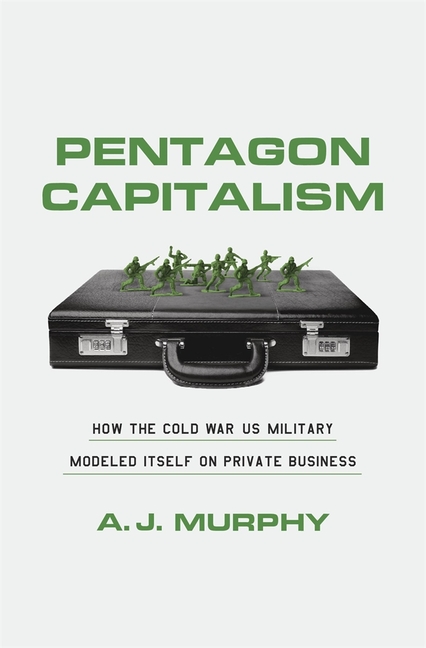
Pentagon Capitalism: How the Cold War Us Military Modeled Itself on Private Business - Hardcover
by A. J. Murphy
$34.99
$39.95
-12%Quantity
01
Pay over time for orders over $35.00 with
Offers & Perks
Earn 34 points with this purchase
Added to your rewards balance after checkout.
100 points welcome bonus
Create an account and start with extra points.
Availability:In StockContributor:A. J. MurphyTheme:Chronological Period/20th CenturyPublish date:8/4/2026Pages:272
Languages:EnglishPublisher:Harvard University PressISBN-13:9780674272811ISBN-10:0674272811UPC:9780674272811Book Category:Political Science, Business & Economics, HistoryBook Subcategory:Public Policy, Government & Business, MilitaryBook Topic:Military Policy, United StatesSize:9.50 x 6.18 x 0.97 inchesWeight:0.599Product ID:SCJKTFTCDX
A pioneering study of the Cold War military-industrial complex shows how defense leaders reorganized the US armed forces in the image of commercial enterprise.
The strategic landscape of the Cold War generated political support for a permanent US military force of unprecedented scale. Faced with the problem of managing this behemoth, leaders of the defense bureaucracy looked to private industry for inspiration: since the military now resembled a huge industrial conglomerate, they reasoned, it should be run like a business. A. J. Murphy explores the profound consequences of translating military structures of command, logistics, and warfare into capitalist terms. In the realm of budgeting and finance, defense reformers refashioned the supply process as a buy-and-sell transaction between units, requiring officers to express their need for equipment and labor in dollar terms. Bureaucrats embraced Taylorist work measurement to supervise everything from clerical filing to the production of massive weapons systems. The services even engaged management consultants to establish officer-training academies modeled on the Harvard Business School. After the Vietnam War, many military leaders pushed back, questioning "managerialism" and calling for a return to traditional concepts of command. Civilian critics also chimed in, protesting the callousness of the business-minded secretary of defense, Robert McNamara, who famously measured success and failure in body counts. By this time, however, the language and values of management had thoroughly infiltrated the military's institutional structure and daily operations. As Pentagon Capitalism makes clear, the reorganization of the defense bureaucracy along the lines of a for-profit firm durably altered the experience of military work and facilitated the lasting privatization of US national security.Languages:EnglishPublisher:Harvard University PressISBN-13:9780674272811ISBN-10:0674272811UPC:9780674272811Book Category:Political Science, Business & Economics, HistoryBook Subcategory:Public Policy, Government & Business, MilitaryBook Topic:Military Policy, United StatesSize:9.50 x 6.18 x 0.97 inchesWeight:0.599Product ID:SCJKTFTCDX
Murphy, A. J.: - A. J. Murphy is Assistant Professor of History at Brandeis University.
Publisher: Harvard University Press
Contributor(s)
Author
Free shipping on orders over $75. Standard shipping takes 3-7 business days. Eligible items may be returned within 30 days of delivery. Conditions apply.