
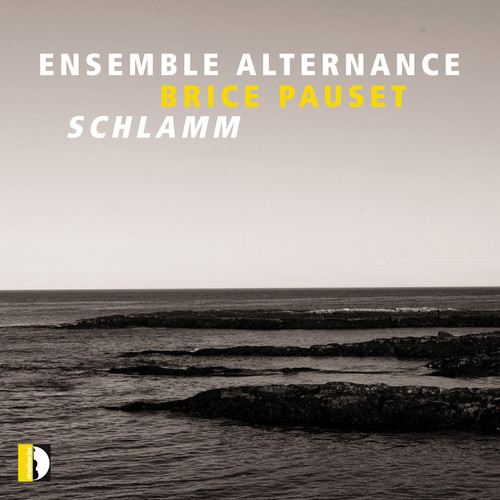
Schlamm
$14.99
$18.99
-21%Quantity
01
Pay over time for orders over $35.00 with
Availability:In StockArtists:Pauset, Ensemble Alternance, DumayGenre:ClassicalRelease date:4/5/2019Original year:2019
Publisher:Alliance EntertainmentLabel:STUUPC:8011570371218Weight:0.25Discs:1Product ID:SCZ651W0RR
Composer Brice Pauset writes: "Eurydice" is an isolated work and unlike the other works does not belong to a cycle. "Eurydice" is related to an experience of thinking, one of my favorite concerns. In this particular case and following to the ideological line rather closed to that of the philosopher Slavoj Zizek, it consists in revisiting a myth which accustomed to us to a single point of view, that of a victorious hero. Here I am interested in the subjectivity of the unfortunate and powerless heroine or more exactly an heroine condemned to unpower..."Un-Ruhe" (upheaval) is a cycle of four works gathering three main ideas under different ways: chattering voice, harpischord and a spacialized and in a three groups divided orchestra. The complete cycle is a critic of democracy in it's today normative form and refers easily to experiences of thinking: There are two litterary sources in the first piece: firstly Rosa Luxemburg, one of the most radical main figure of our past revolution history recognized by the global oligarchy as a past figure and for that reason has to be ignored; and secondly some graffitis, banners, anonymous tracts seen on Tahrir Place in Cairo: still alive traces of a recent revolution but acceptable because of the distance. "Theorie der Tränen" (Theory of tears) is the main title of a perfect informal cycle: works are gathering according to meetings and readings. Here I am interested in the interference of an uncontrolled subjective element, our own tears, but considered as a signal of realities seen as objective and significant: a social reality, a specific codification of interpersonal relations, the descrambling of specific affects. "Schlamm" (mud in English) is related to the World War I. The last survivors of this massacre have discreetly passed away. To talk about the experience of the trenches was hard, almost impossible for them. At a moment tears prevent from speaking. But the witness will often have time enough to speak about another fluid : mud. This almost half-an-hour long piece aims to build an incomplete, heterogeneous and rough process with these two materials."
Publisher:Alliance EntertainmentLabel:STUUPC:8011570371218Weight:0.25Discs:1Product ID:SCZ651W0RR
Publisher: Alliance Entertainment
Label: STU
Artist(s)
Free shipping on orders over $75. Standard shipping takes 3-7 business days. Returns accepted within 30 days of purchase.