
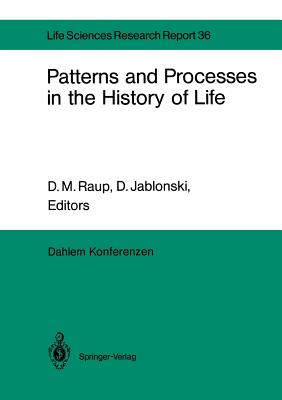
Patterns and Processes in the History of Life: Report of the Dahlem Workshop on Patterns and Processes in the History of Life Berlin 1985, June 16-21 - Paperback
$168.99
$169.99
-1%Quantity
01
Pay over time for orders over $35.00 with
Offers & Perks
Earn 168 points with this purchase
Added to your rewards balance after checkout.
100 points welcome bonus
Create an account and start with extra points.
Availability:In StockContributor:D. Jablonski, D. M. Raup, K. W. FlessaSeries:Dahlem Workshop ReportPublish date:11/17/2011Pages:450
Languages:EnglishPublisher:SpringerISBN-13:9783642708336ISBN-10:3642708331UPC:9783642708336Book Category:Science, MedicalBook Subcategory:Life Sciences, NeuroscienceBook Topic:Evolution, NeuroscienceSize:8.27 x 5.83 x 0.94 inchesWeight:0.554Product ID:SCNRWHMZEE
Hypothesis testing is not a straightforward matter in the fossil record and here, too interactions with biology can be extremely profitable. Quite simply, predictions regarding long-term consequences of processes observed in liv- ing organisms can be tested directly using paleontological data if those liv- ing organisms have an adequate fossil record, thus avoiding the pitfalls of extrapolative approaches. We hope to see a burgeoning of this interactive effort in the coming years. Framing and testing of hypotheses in paleon- tological subjects inevitably raises the problem of inferring process from pattern, and the consideration and elimination of a broad range of rival hy- is an essential procedure here. In a historical science such as potheses paleontology, the problem often arises that the events that are of most in- terest are unique in the history of life. For example, replication of the metazoan radiation at the beginning of the Cambrian is not feasible. How- ever, decomposition of such problems into component hypotheses may at least in part alleviate this difficulty. For example, hypotheses built upon the role of species packing might be tested by comparing evolutionary dy- namics (both morphological and taxonomic) during another global diversi- fication, such as the biotic rebound from the end-Permian extinction, which removed perhaps 95% of the marine species (see Valentine, this volume). The subject of extinction, and mass extinction in particular, has become important in both paleobiology and biology.
Languages:EnglishPublisher:SpringerISBN-13:9783642708336ISBN-10:3642708331UPC:9783642708336Book Category:Science, MedicalBook Subcategory:Life Sciences, NeuroscienceBook Topic:Evolution, NeuroscienceSize:8.27 x 5.83 x 0.94 inchesWeight:0.554Product ID:SCNRWHMZEE
Publisher: Springer
Edition
Softcover Repri Edition
Contributor(s)
Free shipping on orders over $75. Standard shipping takes 3-7 business days. Returns accepted within 30 days of purchase.