
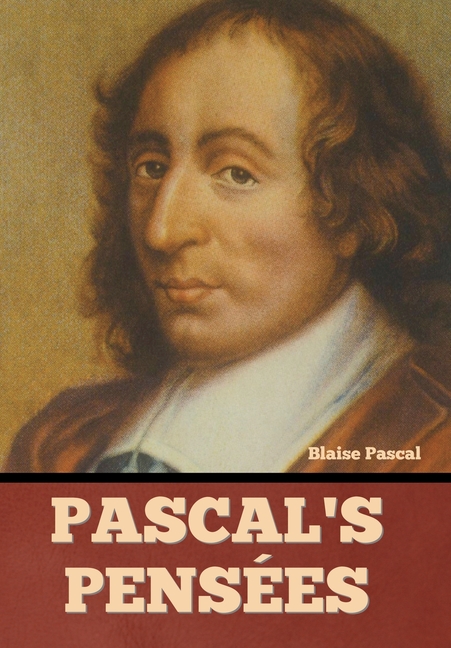
Pascal's Pensees - Hardcover
Choose Option


Pay over time for orders over $35.00 with
Offers & Perks
Earn 28 points with this purchase
Added to your rewards balance after checkout.
100 points welcome bonus
Create an account and start with extra points.
The Pensées ("Thoughts") is a collection of fragments written by the French 17th-century philosopher and mathematician Blaise Pascal. Pascal's religious conversion led him into a life of asceticism, and the Pensées was in many ways his life's work. It represented Pascal's defense of the Christian religion, and the concept of "Pascal's wager" stems from a portion of this work.
Blaise Pascal (19 June 1623 - 19 August 1662) was a French mathematician, physicist, inventor, philosopher, and Catholic writer.
He was a child prodigy who was educated by his father, a tax collector in Rouen. Pascal's earliest mathematical work was on conic sections; he wrote a significant treatise on the subject of projective geometry at the age of 16. He later corresponded with Pierre de Fermat on probability theory, strongly influencing the development of modern economics and social science. In 1642, while still a teenager, he started some pioneering work on calculating machines (called Pascal's calculators and later Pascalines), establishing him as one of the first two inventors of the mechanical calculator.
Like his contemporary René Descartes, Pascal was also a pioneer in the natural and applied sciences. Pascal wrote in defense of the scientific method and produced several controversial results. He made important contributions to the study of fluids, and clarified the concepts of pressure and vacuum by generalising the work of Evangelista Torricelli. Following Torricelli and Galileo Galilei, he rebutted the likes of Aristotle and Descartes who insisted that nature abhors a vacuum in 1647.
In 1646, he and his sister Jacqueline identified with the religious movement within Catholicism known by its detractors as Jansenism. Following a religious experience in late 1654, he began writing influential works on philosophy and theology. His two most famous works date from this period: the Lettres provinciales and the Pensées, the former set in the conflict between Jansenists and Jesuits. The latter contains Pascal's Wager, known in the original as the Discourse on the Machine, a fideistic probabilistic argument for God's existence. In that year, he also wrote an important treatise on the arithmetical triangle. Between 1658 and 1659, he wrote on the cycloid and its use in calculating the volume of solids.
Throughout his life, Pascal was in frail health, especially after the age of 18; he died just two months after his 39th birthday. (wikipedia.org)
Free shipping on orders over $75. Standard shipping takes 3-7 business days. Eligible items may be returned within 30 days of delivery. Conditions apply.