
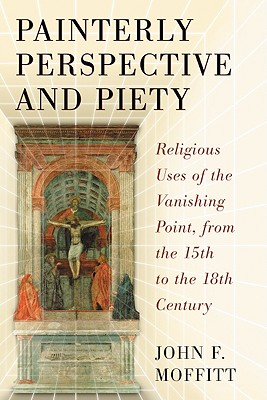
Painterly Perspective and Piety: Religious Uses of the Vanishing Point, from the 15th to the 18th Century - Paperback
Pay over time for orders over $35.00 with
Offers & Perks
Earn 54 points with this purchase
Added to your rewards balance after checkout.
100 points welcome bonus
Create an account and start with extra points.
While the Renaissance is generally perceived to be a secular movement, the majority of large artworks executed in 15th century Italy were from ecclesiastical commissions. Because of the nature of primarily basilica-plan churches, a parishioner's view was directed by the diminishing parallel lines formed by the walls of the structure. Appearing to converge upon a mutual point, this resulted in an artistic phenomenon known as the vanishing point. As applied to ecclesiastical artwork, the Catholic Vanishing Point (CVP) was deliberately situated upon or aligned with a given object--such as the Eucharist wafer or Host, the head of Christ or the womb of the Virgin Mary--possessing great symbolic significance in Roman liturgy. Masaccio's fresco painting of the Trinity (circa 1427) in the Florentine church of Santa Maria Novella, analyzed in physical and symbolic detail, provides the first illustration of a consistently employed linear perspective within an ecclesiastical setting. Leonardo's Last Supper, Venaziano's St. Lucy Altarpiece, and Tome's Transparente illustrate the continuation of this use of liturgical perspective.
Contributor(s)
Author
Free shipping on orders over $75. Standard shipping takes 3-7 business days. Eligible items may be returned within 30 days of delivery. Conditions apply.