
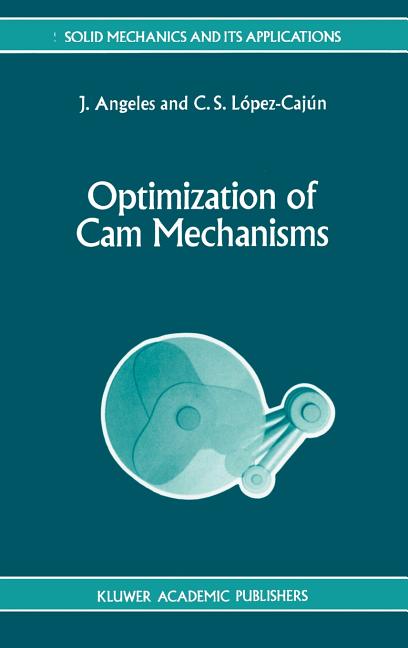
Optimization of CAM Mechanisms - Hardcover
$217.99
$219.99
-1%Quantity
01
Pay over time for orders over $35.00 with
Offers & Perks
Earn 217 points with this purchase
Added to your rewards balance after checkout.
100 points welcome bonus
Create an account and start with extra points.
Availability:In StockContributor:J. AngelesSeries:Solid Mechanics and Its ApplicationsPublish date:8/31/1991Pages:259
Languages:EnglishPublisher:SpringerISBN-13:9780792313557ISBN-10:0792313550UPC:9780792313557Book Category:Science, Technology & EngineeringBook Subcategory:Mechanics, Mechanical, EnergySize:9.70 x 6.28 x 0.84 inchesWeight:0.604Product ID:SCAT9SS6P2
1. 1 Preliminary Concepts A cam mechanism is a mechanical system consisting of three basic components: a driving element, called the cam; a driven element, termed the follower; and a fixed frame. Sometimes, an intermediate element is introduced between the cam and the follower with the purpose of improving the mechanism performance. This element is called the roller because function is to produce a pure-rolling relative motion be- tween the cam and the follower. The purpose ofa cam mechanism is the transmission of power or information. In applications concerning power transmission, the main good to be transmitted is force or torque; in applications ofinformation transmission, the main good transmitted takes the form of motion signals. Most modern appli- cations of cam mechanisms, to be described shortly, are of the former type. Cam mechanisms used for information transmission were traditionally found in measuring instruments. With the advent ofmodern microprocessor-based hardware, this typeof application is becoming less common. Nevertheless, cam mechanisms are still used in a wide spectrum of applications, especially in automatic machines and instruments, textile machinery, computers, printing presses, food-processing equipment, internal combustion engines, control systems, and photographic equipment (Prenzel, 1989). In the design of cam mechanisms, the engineer performs several activities, namely, task definition, synthesis, analysis, optimization, and dynamic simulation. These tasks do not always follow this order. In fact, some loops may appear in the foregoing tasks, such as those illustrated in Fig. 1. 1. 1.
Languages:EnglishPublisher:SpringerISBN-13:9780792313557ISBN-10:0792313550UPC:9780792313557Book Category:Science, Technology & EngineeringBook Subcategory:Mechanics, Mechanical, EnergySize:9.70 x 6.28 x 0.84 inchesWeight:0.604Product ID:SCAT9SS6P2
Free shipping on orders over $75. Standard shipping takes 3-7 business days. Eligible items may be returned within 30 days of delivery. Conditions apply.