
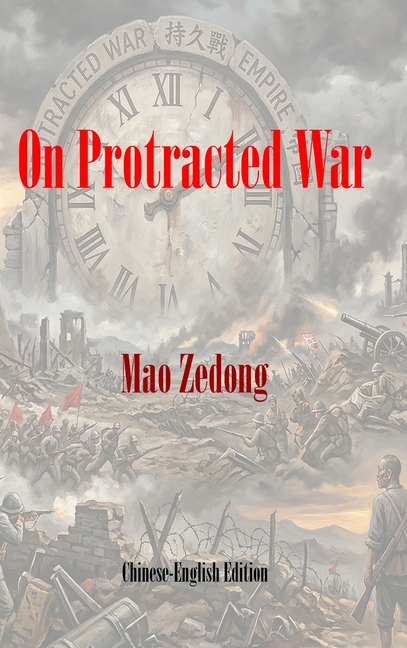
On Protracted War - Hardcover
Pay over time for orders over $35.00 with
Offers & Perks
Earn 29 points with this purchase
Added to your rewards balance after checkout.
100 points welcome bonus
Create an account and start with extra points.
Originally delivered as a series of lectures in Yan'an in 1938, On Protracted War stands as one of the most influential strategic treatises of the twentieth century. Written during the early stages of the Sino-Japanese War, Mao Zedong systematically dismantles both defeatist "national subjugation" narratives and impulsive "quick victory" fantasies, arguing instead that China's path to liberation lies in a deliberately protracted struggle. Through a dialectical analysis of strength and weakness, territory and population, and justice versus barbarism, Mao outlines a three-stage progression-strategic defense, stalemate, and counteroffensive-while elevating political mobilization, guerrilla tactics, and human agency over mere material superiority. This 2026 edition, prepared by the Institute for Integrated Systems Thinking, pairs a meticulous formal translation with an original foreword that reframes Mao's military theory through a contemporary Systems Thinking Framework. By drawing structural parallels to Ibn Khaldūn's sociology of power and treating time, work, and social energy as dynamic variables, the volume reveals the text's enduring relevance not only as a manual of asymmetric warfare, but as a profound study of how weaker systems can achieve systemic transformation through strategic patience, collective solidarity, and adaptive resilience.
Mao Zedong (1893-1976) was a Chinese revolutionary, political theorist, and the founding father of the People's Republic of China. Rising from rural Hunan to lead the Chinese Communist Party through decades of civil conflict and foreign invasion, Mao developed a distinctive Marxist-Leninist approach adapted to China's agrarian and semi-colonial reality. His military and political writings, composed largely during the Yan'an period, revolutionized the theory of people's war by centering mass mobilization, political education, and strategic flexibility over conventional firepower. On Protracted War (1938) emerged at a critical juncture in the Second Sino-Japanese War, when Mao's leadership helped unify fragmented resistance forces and establish a coherent strategic doctrine that would ultimately shape the course of Asian and global anti-imperial movements. Beyond his political legacy, Mao remains a seminal figure in twentieth-century strategic thought, with his analyses of asymmetric conflict, revolutionary organization, and the dialectics of power continuing to inform military academies, political theorists, and scholars of systemic transformation worldwide.
Contributor(s)
Authors
Free shipping on orders over $75. Standard shipping takes 3-7 business days. Eligible items may be returned within 30 days of delivery. Conditions apply.