
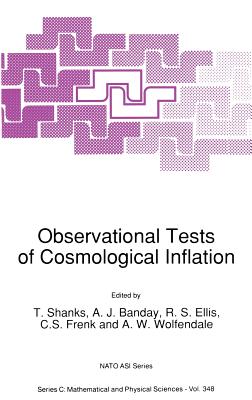
Observational Tests of Cosmological Inflation - Hardcover
$217.99
$219.99
-1%Quantity
01
Pay over time for orders over $35.00 with
Offers & Perks
Earn 217 points with this purchase
Added to your rewards balance after checkout.
100 points welcome bonus
Create an account and start with extra points.
Availability:In StockContributor:T. Shanks, A. J. Banday, Richard S. EllisSeries:NATO Science Series C:Publish date:9/30/1991Pages:483
Languages:EnglishPublisher:SpringerISBN-13:9780792314318ISBN-10:079231431XUPC:9780792314318Book Category:ScienceBook Subcategory:Space Science, PhysicsBook Topic:Astronomy, Cosmology, NuclearSize:9.21 x 6.14 x 1.13 inchesWeight:0.885Product ID:SCSB791TDY
This book represents the proceedings from the NATO sponsored Advanced Research Workshop entitled "Observational Tests of Inflation" held at the University of Durham, England on the 10th-14th December, 1990. In recent years, the cosmological inflation model has drawn together the worlds of particle physics, theoretical cosmology and observational astronomy. The aim of the workshop was to bring together experts in all of these fields to discuss the current status of the inflation theory and its observational predictions. The simplest inflation model makes clear predictions which are testable by astronomical observation. Foremost is the prediction that the cosmological density parameter, no, should have a value negligibly different from the critical, Einstein-de Sitter value of 00=1. The other main prediction is that the spectrum of primordial density fluctuations should be Gaussian and take the Harrison-Zeldovich form. The prediction that n =l, in patticular, leads to several important consequences o for cosmology. Firstly, there is the apparent contradiction with the limits on baryon density from Big Bang nucleosynthesis which has led to the common conjecture that weakly interacting particles rather than baryons may form the dominant mass constituent of the Universe. Secondly, with n =l, the age of the Universe is uncomfortably short if o the Hubble constant and the ages of the oldest star clusters lie within their currently believed limits.
Languages:EnglishPublisher:SpringerISBN-13:9780792314318ISBN-10:079231431XUPC:9780792314318Book Category:ScienceBook Subcategory:Space Science, PhysicsBook Topic:Astronomy, Cosmology, NuclearSize:9.21 x 6.14 x 1.13 inchesWeight:0.885Product ID:SCSB791TDY
Publisher: Springer
Edition
1991 Edition
Contributor(s)
Free shipping on orders over $75. Standard shipping takes 3-7 business days. Returns accepted within 30 days of purchase.