
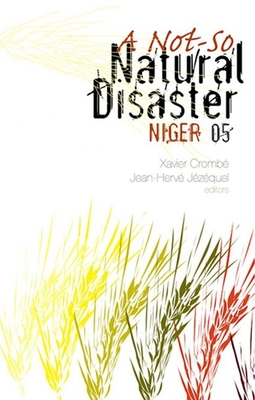
Not-So Natural Disaster: Niger 2005 - Hardcover
$43.99
Quantity
01
Pay over time for orders over $35.00 with
Offers & Perks
Earn 43 points with this purchase
Added to your rewards balance after checkout.
100 points welcome bonus
Create an account and start with extra points.
Availability:In StockContributor:Xavier Crombe, Jean-Herve JezequelTheme:Cultural Region/African, Cultural Region/Asian, Religious Orientation/IslamicPublish date:6/22/2009Pages:276
Languages:EnglishPublisher:Hurst & Co.ISBN-13:9781849043502ISBN-10:1849043507UPC:9781849043502Book Category:Literary Criticism, History, Political ScienceBook Subcategory:Asian, World, International RelationsSize:8.86 x 5.82 x 0.77 inchesWeight:0.44Product ID:SCGW05T72W
Although the term "natural disaster" applies to the December 2004 tsunami, the images of huge devastation that were televised after the tragedy probably seemed a good deal less "natural" to us than those of starving African children we saw seven months later, from Niger. The tsunami was perceived as so "un-natural" that it provoked an immediate, unprecedented international outpouring of sympathy. It took many months, by contrast, for the story of a new famine in the Sahel to make headlines. From the outset its causes were apparent in media coverage-droughts and locust invasions have always seemed the everyday lot of people living in this region. The link between the crisis and its natural causes was so self-evident that the first news reports tended to omit the point that, in reality, drought and the locust invasion had overtaken the Sahel region a year earlier. Nevertheless it became Medecins Sans Frontieres' aim to see it acknowledged-not in the press, but among those institutions responsible for food security in Niger-that the deaths of tens of thousands of children as a result of malnutrition would not be considered "natural" phenomenon, still less a normal one. For this reason the 2005 crisis was a unique experience for the humanitarian organisation. MSF treated more than 60,000 children suffering from severe malnutrition-one of the most ambitious operations in its history. It also found itself embroiled in controversy among the various national and international actors involved in managing the crisis in Niger over the summer of 2005. At the very moment MSF was straining to mobilise other actors to intervene in what it judged to be an emergency situation, the NGO was undergoing heated argument and intense inquiry as to the exact nature of the situation it was attempting to manage. Public, operational involvement of this kind--outside the conflict zones where MSF traditionally and typically intervenes, moreover--called for some form of reflection. This book makes no claim whatsoever to be comprehensive, or to provide a final, definitive version of "the truth" with respect to the 2005 famine in Niger. Instead the contributors endeavor to shed new light on a multifaceted crisis.
Languages:EnglishPublisher:Hurst & Co.ISBN-13:9781849043502ISBN-10:1849043507UPC:9781849043502Book Category:Literary Criticism, History, Political ScienceBook Subcategory:Asian, World, International RelationsSize:8.86 x 5.82 x 0.77 inchesWeight:0.44Product ID:SCGW05T72W
Xavier Crombe is the research director of Médecins Sans Frontières, Paris. Jean-Herve Jezequel, a historian of Africa, is an academic advisor to MSF.
Publisher: Hurst & Co.
Contributor(s)
Free shipping on orders over $75. Standard shipping takes 3-7 business days. Eligible items may be returned within 30 days of delivery. Conditions apply.