
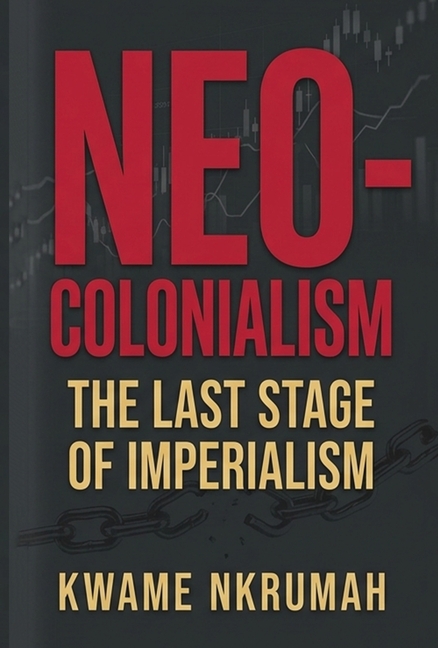
Neo-Colonialism: The Last Stage of Imperialism - Paperback
$32.99
$44.95
-27%Quantity
01
Pay over time for orders over $35.00 with
Offers & Perks
Earn 32 points with this purchase
Added to your rewards balance after checkout.
100 points welcome bonus
Create an account and start with extra points.
Languages:EnglishPublisher:Black Legacy PressISBN-13:9781636525358ISBN-10:1636525350UPC:9781636525358Book Category:Biography & Autobiography, EducationSize:9.00 x 6.00 x 0.63 inchesWeight:0.404Product ID:SCFR6CCE69
THE neo-colonialism of today represents imperialism in its final and perhaps its most dangerous stage. In the past it was possible to convert a country upon which a neo-colonial regime had been imposed - Egypt in the nineteenth century is an example - into a colonial territory. Today this process is no longer feasible. Old-fashioned colonialism is by no means entirely abolished. It still constitutes an African problem, but it is everywhere on the retreat. Once a territory has become nominally independent it is no longer possible, as it was in the last century, to reverse the process. Existing colonies may linger on, but no new colonies will be created. In place of colonialism as the main instrument of imperialism we have today neo-colonialism.The essence of neo-colonialism is that the State which is subject to it is, in theory, independent and has all the outward trappings of international sovereignty. In reality its economic system and thus its political policy is directed from outside.The methods and form of this direction can take various shapes. For example, in an extreme case the troops of the imperial power may garrison the territory of the neo-colonial State and control the government of it. More often, however, neo-colonialist control is exercised through economic or monetary means. The neo-colonial State may be obliged to take the manufactured products of the imperialist power to the exclusion of competing products from elsewhere. Control over government policy in the neo-colonial State may be secured by payments towards the cost of running the State, by the provision of civil servants in positions where they can dictate policy, and by monetary control over foreign exchange through the imposition of a banking system controlled by the imperial power.Where neo-colonialism exists the power exercising control is often the State which formerly ruled the territory in question, but this is not necessarily so. For example, in the case of South Vietnam the former imperial power was France, but neo-colonial control of the State has now gone to the United States. It is possible that neo-colonial control may be exercised by a consortium of financial interests which are not specifically identifiable with any particular State. The control of the Congo by great international financial concerns is a case in point.The result of neo-colonialism is that foreign capital is used for the exploitation rather than for the development of the less developed parts of the world. Investment under neo-colonialism increases rather than decreases the gap between the rich and the poor countries of the world.
From the introduction
Languages:EnglishPublisher:Black Legacy PressISBN-13:9781636525358ISBN-10:1636525350UPC:9781636525358Book Category:Biography & Autobiography, EducationSize:9.00 x 6.00 x 0.63 inchesWeight:0.404Product ID:SCFR6CCE69
Free shipping on orders over $75. Standard shipping takes 3-7 business days. Eligible items may be returned within 30 days of delivery. Conditions apply.