
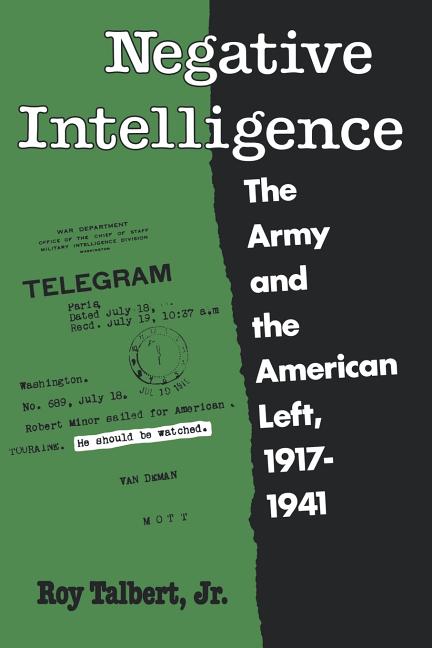
Negative Intelligence: The Army and the American Left, 1917-1941 - Paperback
$38.99
Quantity
01
Pay over time for orders over $35.00 with
Offers & Perks
Earn 38 points with this purchase
Added to your rewards balance after checkout.
100 points welcome bonus
Create an account and start with extra points.
Availability:In StockContributor:Roy Jr. TalbertSeries:Twentieth-Century AmericaTheme:Chronological Period/20th CenturyPublish date:7/1/1991Pages:303
Languages:EnglishPublisher:University Press of MississippiISBN-13:9781604731804ISBN-10:160473180XUPC:9781604731804Book Category:History, Political ScienceBook Subcategory:Military, United States, Intelligence & EspionageBook Topic:20th CenturySize:9.00 x 6.00 x 0.73 inchesWeight:0.481Product ID:SC0T27Q943
Negative Intelligence: The Army and the American Left, 1917-1941 by Roy Talbert, Jr. During World War I, in the period of the Red Scare, and throughout the Great Depression, the army's domestic spy agency mounted an extensive surveillance campaign focused on civilians and groups deemed subversive. This book traces the fascinating and astonishing story of military espionage on the home front. Created by Major General Ralph H. Van Deman in 1917, the Negative Branch of Military Intelligence, or MI, spied on American reformers in a program of civilian surveillance that surpassed even that of the Department of Justice's Bureau of Investigation. Among the targets were the Industrial Workers of the World, the American Civil Liberties Union, and "Negro Subversion." Documentation of MI's program of domestic espionage is from recently opened Military Intelligence archives. Closely allied with private vigilante groups, the Army conducted illegal raids, made illegal arrests, subjected many citizens to interrogation, and developed an elaborate filing system for its dossiers. After World War I the hysteria continued, with MI's direct focus beamed upon a new enemy, the Bolsheviki. Although MI's abuses have been overshadowed by those of the Department of Justice, army espionage was in many ways more aggressive than its civilian counterpart. Negative Intelligence documents these abuses and shows how until 1921 the attempts to restrain MI's work failed. After this time, with limited staff and funding MI could do no more than maintain close liaison with private super-patriotic groups. However, the coming of the Great Depression fired up the rebirth of the army's civilian espionage programs. Then as World War II approached, internal security once again became a national policy, and J. Edgar Hoover of the Federal Bureau of Investigation moved his powerful network into the supreme position of domestic spying. Roy Talbert, Jr. is a professor of history at the University of South Carolina's Coastal Carolina College.
Languages:EnglishPublisher:University Press of MississippiISBN-13:9781604731804ISBN-10:160473180XUPC:9781604731804Book Category:History, Political ScienceBook Subcategory:Military, United States, Intelligence & EspionageBook Topic:20th CenturySize:9.00 x 6.00 x 0.73 inchesWeight:0.481Product ID:SC0T27Q943
Roy Talbert Jr. teaches history at the University of South Carolina's Coastal Carolina College.
Publisher: University Press of Mississippi
Contributor(s)
Author
Free shipping on orders over $75. Standard shipping takes 3-7 business days. Returns accepted within 30 days of purchase.