
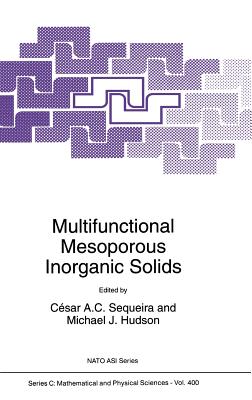
Multifunctional Mesoporous Inorganic Solids - Hardcover
$217.99
$219.99
-1%Quantity
01
Pay over time for orders over $35.00 with
Offers & Perks
Earn 217 points with this purchase
Added to your rewards balance after checkout.
100 points welcome bonus
Create an account and start with extra points.
Availability:In StockContributor:Michael J. HudsonSeries:NATO Science Series C:Publish date:5/31/1993Pages:502
Languages:EnglishPublisher:SpringerISBN-13:9780792322894ISBN-10:0792322894UPC:9780792322894Book Category:Technology & Engineering, ScienceBook Subcategory:Materials Science, ChemistryBook Topic:Physical & Theoretical, InorganicSize:9.21 x 6.14 x 1.13 inchesWeight:0.917Product ID:SC9N1NRTYA
1. Introduction. There is much interest in the general subject of porous inorganic materials with respect to their use as sorbents or catalysts. Such inorganic solids may be microporous, mesoporous or macroporous according to the sizes of the pores within the solid. Often there is a range of pore sizes within any given solid and so there is special interest in the synthesis, characterisation and application of porous inorganic solids with well defined pores. Pores of diameter larger than 50 nm are generally termed macropores. Those with diameters of less than 2 nm are micropores and pores of intermediate size are called mesopores. Solids, which contain only mesopores, are correctly called mesoporous but very often there is a combination of different types of porosities within one given solid. The synthesis, characterisation and application of microporous solids is much more advanced than is the case with mesoporous substances. Moreover, the synthesis of crystalline mesoporous materials is one clear goal for the future but which has not been attained so far. Consequently, it is of interest to examine the current state of our knowledge of microporous materials and to examine how this may apply to mesoporous materials. Both catalytic and sorption processes could benefit from studies of mesoporous solids because the mesopores could permit diffusion of larger reactants or products than is the case in microporous materials. 2.
Languages:EnglishPublisher:SpringerISBN-13:9780792322894ISBN-10:0792322894UPC:9780792322894Book Category:Technology & Engineering, ScienceBook Subcategory:Materials Science, ChemistryBook Topic:Physical & Theoretical, InorganicSize:9.21 x 6.14 x 1.13 inchesWeight:0.917Product ID:SC9N1NRTYA
Publisher: Springer
Edition
1993 Edition
Contributor(s)
Free shipping on orders over $75. Standard shipping takes 3-7 business days. Returns accepted within 30 days of purchase.