
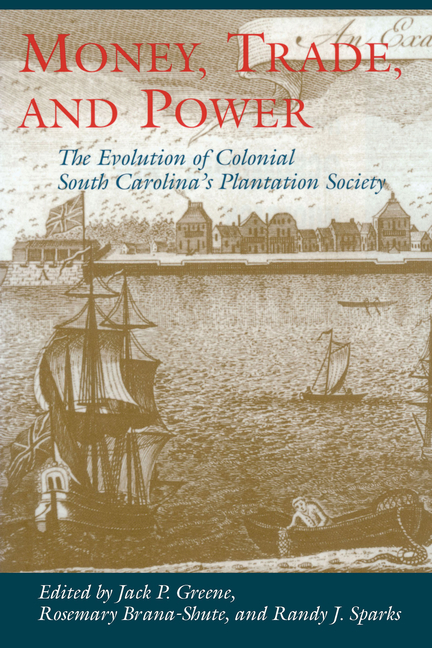
Money, Trade, and Power: The Evolution of Colonial South Carolina's Plantation Society - Hardcover
$57.99
Quantity
01
Pay over time for orders over $35.00 with
Offers & Perks
Earn 57 points with this purchase
Added to your rewards balance after checkout.
100 points welcome bonus
Create an account and start with extra points.
Availability:In StockContributor:Jack P. Greene, Rosemary Brana-Shute, Randy J. SparksSeries:Carolina Lowcountry and the Atlantic WorldTheme:Chronological Period/17th Century, Chronological Period/18th Century, Cultural Region/Deep South, Cultural Region/South, Cultural Region/South Atlantic, Cultural Region/Southeast U.S., Geographic Orientation/South CarolinaPublish date:10/31/2001Pages:416
Languages:EnglishPublisher:University of South Carolina PressISBN-13:9781570033742ISBN-10:1570033749UPC:9781570033742Book Category:History, Social ScienceBook Subcategory:United States, AnthropologyBook Topic:Colonial Period (1600-1775), Cultural & SocialSize:9.38 x 6.30 x 1.27 inchesWeight:0.858Product ID:SCPCJM8DVJ
Reflecting the burgeoning interest of colonial historians in South Carolina and its role as the economic and cultural center of the Lower South, Money, Trade, and Power is a comprehensive exploration of the colony's slave system, economy, and complex social and cultural life. The first six chapters of this essay collection focus on the formative decades of South Carolina's history, from 1670 through the 1730s. Contributors Meaghan N. Duff, Bertrand Van Ruymbeke, and Gary L. Hewitt explore the colony's early settlement. R. C. Nash, Stephen G. Hardy, and Eirlys M. Barker investigate the rapidly expanding economy. Turning to the colony's reliance on slave labor, William L. Ramsay analyzes the institution and abandonment of Indian slavery; Jennifer Lyle Morgan examines the reproductive capabilities of slave women; and S. Max Edelson looks at the distinctive social position of skilled slaves. Robert Olwell considers how South Carolina public officials adapted the office of justice of the peace to the needs of a slave society, while Matthew Mulcahy shows how calamities of fires and hurricanes exacerbated the problem of slave control. Finally, Edward Pearson describes the ways in which South Carolina's emerging elite asserted their new status; G. Winston Lane and Elizabeth M. Pruden review the surprising economic independence of women; and Thomas Little examines the colony's religious life and spread of evangelicalism.
Languages:EnglishPublisher:University of South Carolina PressISBN-13:9781570033742ISBN-10:1570033749UPC:9781570033742Book Category:History, Social ScienceBook Subcategory:United States, AnthropologyBook Topic:Colonial Period (1600-1775), Cultural & SocialSize:9.38 x 6.30 x 1.27 inchesWeight:0.858Product ID:SCPCJM8DVJ
Randy J. Sparks is an associate professor of history at Tulane University and the author of On Jordan's Stormy Banks: Evangelicalism in Mississippi, 1774-1876. Sparks lives in Charleston.
Publisher: University of South Carolina Press
Contributor(s)
Free shipping on orders over $75. Standard shipping takes 3-7 business days. Eligible items may be returned within 30 days of delivery. Conditions apply.