
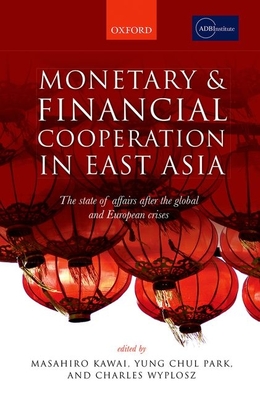
Monetary and Financial Cooperation in East Asia: The State of Affairs After the Global and European Crises - Hardcover
$120.99
Quantity
01
Pay over time for orders over $35.00 with
Offers & Perks
Earn 120 points with this purchase
Added to your rewards balance after checkout.
100 points welcome bonus
Create an account and start with extra points.
Availability:In StockContributor:Masahiro Kawai, Yung Chul Park, Charles WyploszTheme:Interdisciplinary Studies/AsianPublish date:6/16/2015Pages:256
Languages:EnglishPublisher:Oxford University PressISBN-13:9780198714156ISBN-10:0198714157UPC:9780198714156Book Category:Business & EconomicsBook Subcategory:International, Economics, FinanceBook Topic:Economics & Trade, MacroeconomicsSize:9.20 x 6.20 x 0.90 inchesWeight:0.545Product ID:SCTK6YTAPX
The global financial crisis and the Eurozone crisis have led to a profound rethink in East Asia about the international monetary system and regional monetary and financial integration. After the East Asian crisis of 1997, deeper regional cooperation was seen as the way to avoid reliance on the IMF and the rest of the world. Steps were taken, but they were limited because of disagreements reflecting regional rivalries. Still, integration into the global financial system and Europe's regional process were seen as objectives to be adapted to East Asia, as detailed in an overview chapter. The crises have shaken this strategy but also revealed the pre-existing deep disagreements. This book presents contributions by scholars from different countries. Each one was invited to describe the vision of their policymakers. The traidtional rivalry between China and Japan, the region's largest economies, reveals Chinese confidence into its rising power and Japanese growing doubts about its ability to weigh on the debate. For opposite reasons, both display a declining interest into regional cooperation. Korea and the ASEAN countries do not wish to choose between the regional powers but remain attached to regional cooperation and integration. They look for pragmatic solutions that recognize the value-chain characteristic of trade. Additional contributions by US and European scholars provide evaluations of the global and Eurozone crises and of their relevance for East Asian integration.
Languages:EnglishPublisher:Oxford University PressISBN-13:9780198714156ISBN-10:0198714157UPC:9780198714156Book Category:Business & EconomicsBook Subcategory:International, Economics, FinanceBook Topic:Economics & Trade, MacroeconomicsSize:9.20 x 6.20 x 0.90 inchesWeight:0.545Product ID:SCTK6YTAPX
Masahiro Kawai, Professor of Economics, University of Tokyo, Yung Chul Park, Professor of Economics, Korea University, Charles Wyplosz, Professor of International Economics, The Graduate Institute, Geneva Professor Kawai has served as Chief Economist of the World Bank's East Asia and Pacific Region and Dean of the Asian Development Bank Institute. He holds a PhD from Stanford University. Professor Park has served as senior economic adviser to the president of Korea. He holds a PhD from the University of Minnesota. Professor Wyplosz is a frequent consultant to international organizations and various governments. He holds a PhD from Harvard University.
Publisher: Oxford University Press
Contributor(s)
Free shipping on orders over $75. Standard shipping takes 3-7 business days. Returns accepted within 30 days of purchase.