
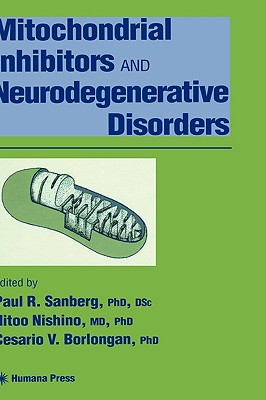
Mitochondrial Inhibitors and Neurodegenerative Disorders - Hardcover
$168.99
$169.99
-1%Quantity
01
Pay over time for orders over $35.00 with
Offers & Perks
Earn 168 points with this purchase
Added to your rewards balance after checkout.
100 points welcome bonus
Create an account and start with extra points.
Availability:In StockContributor:Paul R. Sanberg, Hitoo Nishino, Cesario V. BorlonganSeries:Contemporary NeurosciencePublish date:10/1/1999Pages:314
Languages:EnglishPublisher:HumanaISBN-13:9780896038059ISBN-10:089603805XUPC:9780896038059Book Category:MedicalBook Subcategory:Neuroscience, NeurologySize:9.21 x 6.14 x 0.75 inchesWeight:0.645Product ID:SCHYXX4V45
Mitochondria have long been the Rodney Dangerfield of cellular organelles. Believed to be the remnants of bacterial infection of eukaryotic cells eons ago, the mitochondrion evolved a symbiotic relationship in which it dutifully served as the efficient source of A TP for cell function. The extraordinary dependence of cells on the energy provided by mito- chondrial oxidative metabolism of glucose, especially through critical organs such as the heart and brain, is underlined by the fatal consequences of toxins that interfere with the mitochondrial electron transport system. Consistent with their ancestry, the mitochondria have their own DNA that encodes many but not all of their proteins. The mitochon- dria and their genes come from the mother via the ovum since sperm do not possess mitochondria. This extranuclear form of inheritance derived exclusively from the female side has proven to be a powerful tool for tracing the evolution by the number of base substitutions in mtDNA. That mitochondrial gene mutations might be a source of human dis- ease became evident a decade ago with the characterization of a group of multisystem disorders, typically involving the nervous system, which are transmitted from mother to child. Specific point mutations in mtDNA have been associated with the different syndromes.
Languages:EnglishPublisher:HumanaISBN-13:9780896038059ISBN-10:089603805XUPC:9780896038059Book Category:MedicalBook Subcategory:Neuroscience, NeurologySize:9.21 x 6.14 x 0.75 inchesWeight:0.645Product ID:SCHYXX4V45
Publisher: Humana
Edition
2000 Edition
Contributor(s)
Free shipping on orders over $75. Standard shipping takes 3-7 business days. Eligible items may be returned within 30 days of delivery. Conditions apply.