
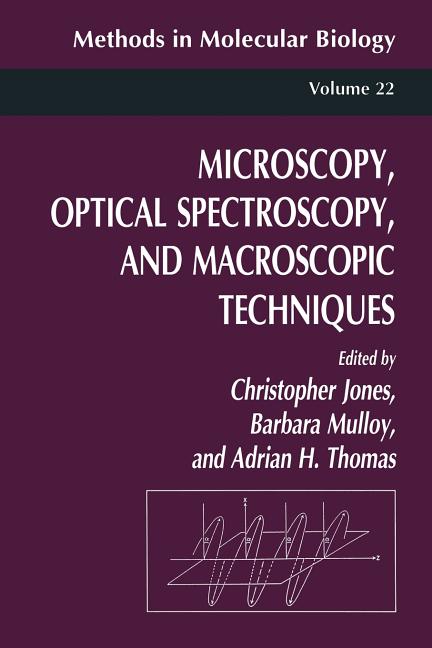
Microscopy, Optical Spectroscopy, and Macroscopic Techniques - Paperback
$108.99
$109.99
-1%Quantity
01
Pay over time for orders over $35.00 with
Offers & Perks
Earn 108 points with this purchase
Added to your rewards balance after checkout.
100 points welcome bonus
Create an account and start with extra points.
Availability:In StockContributor:Christopher Jones, Barbara Mulloy, Adrian H. ThomasSeries:Methods in Molecular BiologyPublish date:8/17/2013Pages:251
This is the second of three volumes of Methods in Molecular Biology that deal with Physical Methods of Analysis. The first of these, Spectroscopic Methods and Analyses dealt with NMR spec- troscopy, mass spectrometry, and metalloprotein techniques, and the third will cover X-ray crystallographic methods. As with the first volume. Microscopy, Optical Spectroscopy, and Macroscopic Techniques is intended to provide a basic understand- ing for the biochemist or biologist who needs to collaborate with spe- cialists in applying the techniques of modern physical chemistry to biological macromolecules. The methods treated in this book fall into four groups. Part One covers microscopy, which aims to visualize individual molecules or complexes of several molecules. Electron microscopy is the more familiar of these, while scanning tunneling microscopy is a new and rapidly developing tool. Methods for determining the shapes and sizes of molecules in solution are described in Part Two, which includes chapters on X-ray and neutron scattering, light scattering, and ult- centrifugation. Calorimetry, described in Part Three, provides the means to monitor processes involving thermodynamic changes, whether these are intramolecular, such as conformational transition, or the interactions between solutes or between a solute and its sol- vent. Part Four is concerned with optical and infrared spectroscopy and describes applications ranging from the measurement of protein concentration by UV absorbance to the analysis of secondary struc- ture using circular dichroism and Fourier-transform infrared spec- troscopy.
Publisher: Humana
Edition
1994 Edition
Contributor(s)
Free shipping on orders over $75. Standard shipping takes 3-7 business days. Eligible items may be returned within 30 days of delivery. Conditions apply.