
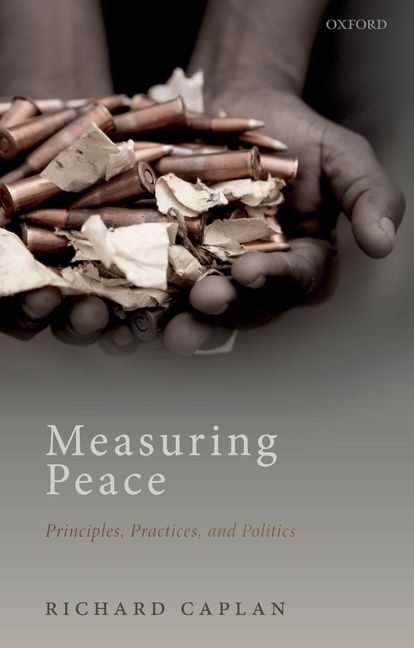
Measuring Peace: Principles, Practices, and Politics - Paperback
$34.99
Quantity
01
Pay over time for orders over $35.00 with
Offers & Perks
Earn 34 points with this purchase
Added to your rewards balance after checkout.
100 points welcome bonus
Create an account and start with extra points.
Languages:EnglishPublisher:Oxford University PressISBN-13:9780198867708ISBN-10:0198867700UPC:9780198867708Book Category:Political Science, Social Science, Technology & EngineeringBook Subcategory:Intelligence & Espionage, Developing & Emerging Countries, Military ScienceSize:8.50 x 5.50 x 0.50 inchesWeight:0.25Product ID:SCTAKZZMF2
How can we know if the peace that has been established following a civil war is a stable peace? More than half of all countries that experienced civil war since World War II have suffered a relapse into violent conflict, in some cases more than once. Meanwhile, the international community expends billions of dollars and deploys tens of thousands of personnel each year in support of efforts to build peace in countries emerging from violent conflict. This book argues that efforts to build peace are hampered by the lack of effective means of assessing progress towards the achievement of a consolidated peace. Rarely, if ever, do peacebuilding organizations and governments seek to ascertain the quality of the peace that they are helping to build and the contribution that their engagement is making (or not) to the consolidation of peace. More rigorous assessments of the robustness of peace are needed. These assessments require clarity about the characteristics of, and the requirements for, a stable peace. This in turn requires knowledge of the local culture, local history, and the specific conflict dynamics at work in a given conflict situation. Better assessment can inform peacebuilding actors in the reconfiguration and reprioritization of their operations in cases where conditions on the ground have deteriorated or improved. To build a stable peace, it is argued here, it is important to take the measure of peace.
Languages:EnglishPublisher:Oxford University PressISBN-13:9780198867708ISBN-10:0198867700UPC:9780198867708Book Category:Political Science, Social Science, Technology & EngineeringBook Subcategory:Intelligence & Espionage, Developing & Emerging Countries, Military ScienceSize:8.50 x 5.50 x 0.50 inchesWeight:0.25Product ID:SCTAKZZMF2
Richard Caplan, Professor of International Relations, University of Oxford bRichard Caplan/b is Professor of International Relations at the University of Oxford. He has written extensively on international organizations and conflict management, specifically on post-conflict peace and state-building. He is the author of International Governance of War-Torn Territories (Oxford University Press, 2005) and Europe and the Recognition of New States in Yugoslavia (Cambridge University Press, 2005), and the editor of Exit Strategies and State Building (OUP, 2012) and Europe's New Nationalism: States and Minorities in Conflict (OUP, 1996). He has served as a Specialist-Advisor to the Select Foreign Affairs Committee of the UK House of Commons, a consultant to the UN Peacebuilding Support Office, and a member of the World Economic Forum's Global Agenda Council on Fragile States.
Publisher: Oxford University Press
Contributor(s)
Author
Free shipping on orders over $75. Standard shipping takes 3-7 business days. Eligible items may be returned within 30 days of delivery. Conditions apply.