
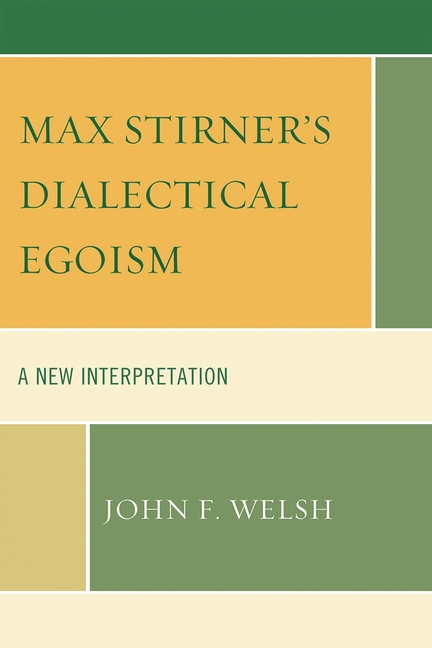
Max Stirner's Dialectical Egoism: A New Interpretation - Paperback
Pay over time for orders over $35.00 with
Offers & Perks
Earn 67 points with this purchase
Added to your rewards balance after checkout.
100 points welcome bonus
Create an account and start with extra points.
Max Stirner (1806-1856) is recognized in the history of political thought because of his egoist classic The Ego and Its Own. Stirner was a student of Hegel, and a critic of the Young Hegelians and the emerging forms of socialist and communist thought in the 1840s. Max Stirner's Dialectical Egoism: A New Interpretation examines Stirner's thought as a critique of modernity, by which he meant the domination of culture and politics by humanist ideology. In Stirner's view, "humanity" is the supreme being of modernity and "humanism" is the prevailing legitimation of social and political domination.
Welsh traces Stirner's thought from his early essays to The Ego and Its Own and Stirner's responses to his critics. He also examines how Benjamin Tucker, James L. Walker, and Dora Marsden applied Stirner's dialectical egoism to the analysis of (a) the transformations of capitalism, (b) culture, ethics, and mass psychology, and (c) feminism, socialism, and communism. All three viewed Stirner as a champion of individuality against the collectivizing and homogenizing forces of the modern world.
Welsh also takes great care to dissociate Stirner's thought from that of the other great egoist critic of modernity, Friedrich Nietzsche. He argues that the similarities in the dissidence of Stirner and Nietzsche are superficial. The book concludes with an interpretation of Stirner's thought as a form of dialectical egoism that includes (a) a multi-tiered analysis of culture, society, and individuality; (b) the basic principles of Stirner's view of the relationship between individuals and social organization; and (c) the forms of critique he employs. Stirner's critique of modernity is a significant contribution to the growing literature on libertarianism, dialectical analysis, and post-modernism.
Contributor(s)
Author
Free shipping on orders over $75. Standard shipping takes 3-7 business days. Eligible items may be returned within 30 days of delivery. Conditions apply.