
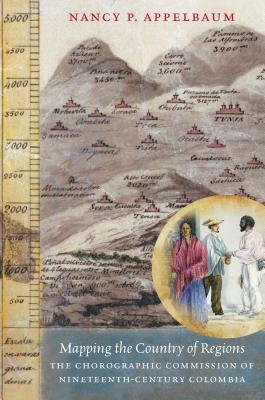
Mapping the Country of Regions: The Chorographic Commission of Nineteenth-Century Colombia - Hardcover
$115.99
Quantity
01
Pay over time for orders over $35.00 with
Offers & Perks
Earn 115 points with this purchase
Added to your rewards balance after checkout.
100 points welcome bonus
Create an account and start with extra points.
Availability:In StockContributor:Nancy P. AppelbaumTheme:Chronological Period/1851-1899, Cultural Region/Latin AmericaPublish date:5/23/2016Pages:320
Languages:EnglishPublisher:University of North Carolina PressISBN-13:9781469628936ISBN-10:1469628937UPC:9781469628936Book Category:History, ScienceBook Subcategory:Latin America, History, Earth SciencesBook Topic:South America, GeographySize:9.21 x 6.14 x 0.88 inchesWeight:0.672Product ID:SCPK8SFMM4
The nineteenth century was an era of breathtakingly ambitious geographic expeditions across the Americas. The seminal Chorographic Commission of Colombia, which began in 1850 and lasted about a decade, was one of Latin America's most extensive. The commission's mandate was to define and map the young republic and its resources with an eye toward modernization. In this history of the commission, Nancy P. Appelbaum focuses on the geographers' fieldwork practices and visual production as the men traversed the mountains, savannahs, and forests of more than thirty provinces in order to delineate the country's territorial and racial composition. Their assumptions and methods, Appelbaum argues, contributed to a long-lasting national imaginary.
What jumps out of the commission's array of reports, maps, sketches, and paintings is a portentous tension between the marked differences that appeared before the eyes of the geographers in the field and the visions of sameness to which they aspired. The commissioners and their patrons believed that a prosperous republic required a unified and racially homogeneous population, but the commission's maps and images paradoxically emphasized diversity and helped create a "country of regions." By privileging the whiter inhabitants of the cool Andean highlands over those of the boiling tropical lowlands, the commission left a lasting but problematic legacy for today's Colombians.
What jumps out of the commission's array of reports, maps, sketches, and paintings is a portentous tension between the marked differences that appeared before the eyes of the geographers in the field and the visions of sameness to which they aspired. The commissioners and their patrons believed that a prosperous republic required a unified and racially homogeneous population, but the commission's maps and images paradoxically emphasized diversity and helped create a "country of regions." By privileging the whiter inhabitants of the cool Andean highlands over those of the boiling tropical lowlands, the commission left a lasting but problematic legacy for today's Colombians.
Languages:EnglishPublisher:University of North Carolina PressISBN-13:9781469628936ISBN-10:1469628937UPC:9781469628936Book Category:History, ScienceBook Subcategory:Latin America, History, Earth SciencesBook Topic:South America, GeographySize:9.21 x 6.14 x 0.88 inchesWeight:0.672Product ID:SCPK8SFMM4
Nancy P. Appelbaum, professor of history at Binghamton University, The State University of New York, is co-editor of Race and Nation in Modern Latin America and author of Muddied Waters: Race, Region, and Local History in Colombia, 1846-1948.
Publisher: University of North Carolina Press
Contributor(s)
Author
Free shipping on orders over $75. Standard shipping takes 3-7 business days. Eligible items may be returned within 30 days of delivery. Conditions apply.