
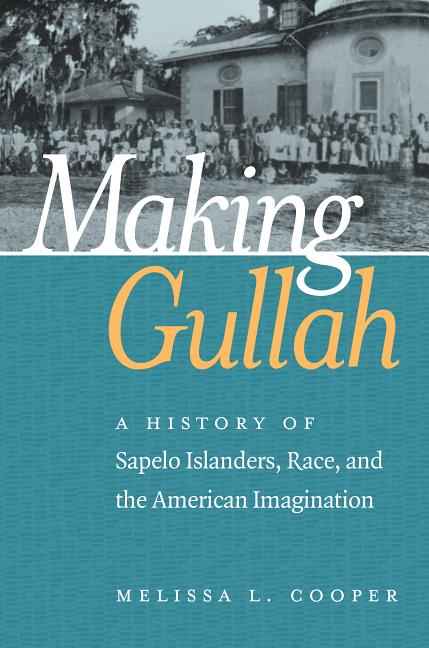
Making Gullah: A History of Sapelo Islanders, Race, and the American Imagination - Hardcover
$115.99
Choose Option
Hardcover
$115.99
$105.00

Making Gullah: A History of Sapelo Islanders, Race, and the American Imagination
$35.99
Quantity
01
Pay over time for orders over $35.00 with
Offers & Perks
Earn 115 points with this purchase
Added to your rewards balance after checkout.
100 points welcome bonus
Create an account and start with extra points.
Availability:In StockContributor:Melissa L. CooperSeries:The John Hope Franklin African American History and CultureTheme:Chronological Period/1920's, Chronological Period/1930's, Cultural Region/South, Cultural Region/Southeast U.S., Ethnic Orientation/African American, Geographic Orientation/Georgia, Topical/Black HistoryPublish date:4/17/2017Pages:304
Languages:EnglishPublisher:University of North Carolina PressISBN-13:9781469632674ISBN-10:1469632675UPC:9781469632674Book Category:History, Social ScienceBook Subcategory:African American & Black, Cultural & Ethnic Studies, United StatesBook Topic:African American & Black Studies, State & LocalSize:9.21 x 6.14 x 0.81 inchesWeight:0.649Product ID:SCP2C88PKN
During the 1920s and 1930s, anthropologists and folklorists became obsessed with uncovering connections between African Americans and their African roots. At the same time, popular print media and artistic productions tapped the new appeal of black folk life, highlighting African-styled voodoo as an essential element of black folk culture. A number of researchers converged on one site in particular, Sapelo Island, Georgia, to seek support for their theories about "African survivals," bringing with them a curious mix of both influences. The legacy of that body of research is the area's contemporary identification as a Gullah community.
This wide-ranging history upends a long tradition of scrutinizing the Low Country blacks of Sapelo Island by refocusing the observational lens on those who studied them. Cooper uses a wide variety of sources to unmask the connections between the rise of the social sciences, the voodoo craze during the interwar years, the black studies movement, and black land loss and land struggles in coastal black communities in the Low Country. What emerges is a fascinating examination of Gullah people's heritage, and how it was reimagined and transformed to serve vastly divergent ends over the decades.
This wide-ranging history upends a long tradition of scrutinizing the Low Country blacks of Sapelo Island by refocusing the observational lens on those who studied them. Cooper uses a wide variety of sources to unmask the connections between the rise of the social sciences, the voodoo craze during the interwar years, the black studies movement, and black land loss and land struggles in coastal black communities in the Low Country. What emerges is a fascinating examination of Gullah people's heritage, and how it was reimagined and transformed to serve vastly divergent ends over the decades.
Languages:EnglishPublisher:University of North Carolina PressISBN-13:9781469632674ISBN-10:1469632675UPC:9781469632674Book Category:History, Social ScienceBook Subcategory:African American & Black, Cultural & Ethnic Studies, United StatesBook Topic:African American & Black Studies, State & LocalSize:9.21 x 6.14 x 0.81 inchesWeight:0.649Product ID:SCP2C88PKN
Cooper, Melissa: - Melissa Cooper is assistant professor of Southern studies at the University of South Carolina.Cooper, Melissa L.: - Melissa L. Cooper is associate professor of history at Rutgers University-Newark.
Publisher: University of North Carolina Press
Contributor(s)
Author
Free shipping on orders over $75. Standard shipping takes 3-7 business days. Eligible items may be returned within 30 days of delivery. Conditions apply.