
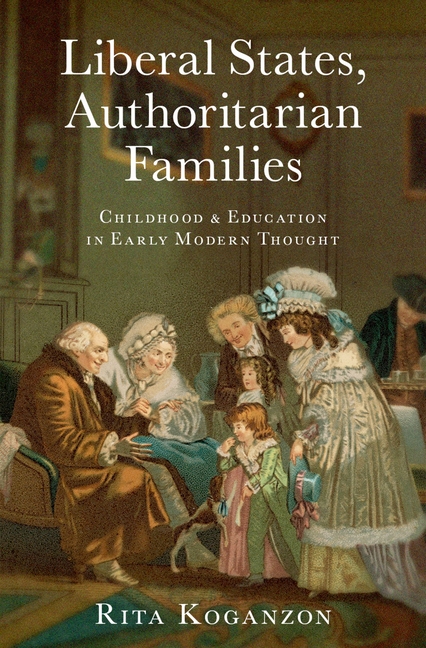
Liberal States, Authoritarian Families: Childhood and Education in Early Modern Thought - Hardcover
$109.99
Quantity
01
Pay over time for orders over $35.00 with
Offers & Perks
Earn 109 points with this purchase
Added to your rewards balance after checkout.
100 points welcome bonus
Create an account and start with extra points.
Languages:EnglishPublisher:Oxford University PressISBN-13:9780197568804ISBN-10:0197568807UPC:9780197568804Book Category:Political Science, Philosophy, HistoryBook Subcategory:History & Theory, Political, Social HistorySize:9.50 x 6.20 x 0.70 inchesWeight:0.499Product ID:SC2F8DZD7N
Children have posed a longstanding dilemma for liberalism. The authority of adults over children has always been difficult to square with liberalism's foundationally anti-authoritarian premises. But since liberal regimes rely heavily on education, finding a way to square adult authority with children's natural liberty is essential. The logic behind anti-authority childrearing and educational advice is that of congruence; to form good citizens of a liberal democracy, families and schools should resemble miniature, protected democracies so that children can practice liberty and equality in a low-risk environment. This kind of congruence between family and state has very old philosophical roots, surfacing first in ancient Greek and Christian thought and re-emerging in its modern form in the seventeenth century. In Liberal States, Authoritarian Families, Rita Koganzon rejects this impulse, demonstrating that it rests on misunderstanding and neglect of the arguments of early liberals--specifically John Locke and Jean-Jacques Rousseau--about what kind of upbringing and education liberal regimes require. Koganzon shows that not only did early liberals emphatically deny the possibility of congruence between pedagogical and political authority, but they counterintuitively demanded that parents and teachers exercise extensive personal authority over children, while denying the legitimacy of such authority over adults in politics. While contemporary theorists argue that the family should be democratized to reflect the egalitarian ideals of the liberal state, this book argues that the desire for "congruence" between familial and state authority was originally illiberal in origin, advanced by theorists of absolute sovereignty like Bodin and Hobbes. Early liberals opposed modelling the family on the state, even on a democratic, egalitarian state, because they viewed the "authoritarian" family as a necessary educational buttress for children against the new fashionable forms of social tyranny that liberal, commercial states would develop. Unlike the old authorities, these forces might leave our bodies and properties alone, but they would subtly and forcefully shape our understandings, subjecting us to a new tyranny of public opinion. Koganzon finds that the educational writings of early liberals reveal an important corrective insight for modern liberalism: authority is not the enemy of liberty, but a necessary prerequisite for it.
Languages:EnglishPublisher:Oxford University PressISBN-13:9780197568804ISBN-10:0197568807UPC:9780197568804Book Category:Political Science, Philosophy, HistoryBook Subcategory:History & Theory, Political, Social HistorySize:9.50 x 6.20 x 0.70 inchesWeight:0.499Product ID:SC2F8DZD7N
Rita Koganzon is the associate director of the Program on Constitutionalism and Democracy and Assistant Professor of Politics (General Faculty) at the University of Virginia. Her research focuses on the themes of education, childhood, authority, and the family in historical and contemporary political thought. Her research has been published in American Political Science Review, Review of Politics, and History of Education Quarterly, as well as in several edited volumes, and she contributes book reviews and essays to Hedgehog Review, National Affairs, The Point, and Chronicle of Higher Education, among others.
Publisher: Oxford University Press
Contributor(s)
Author
Free shipping on orders over $75. Standard shipping takes 3-7 business days. Eligible items may be returned within 30 days of delivery. Conditions apply.