
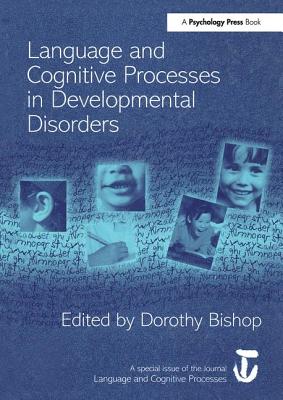
Language and Cognitive Processes in Developmental Disorders: A Special Issue of Language and Cognitive Processes - Paperback
$76.99
Quantity
01
Pay over time for orders over $35.00 with
Offers & Perks
Earn 76 points with this purchase
Added to your rewards balance after checkout.
100 points welcome bonus
Create an account and start with extra points.
Availability:In StockContributor:Dorothy BishopSeries:Special Issues of Language and Cognitive ProcessesPublish date:1/22/2019Pages:228
Languages:EnglishPublisher:RoutledgeISBN-13:9781138877832ISBN-10:1138877832UPC:9781138877832Book Category:PsychologyBook Subcategory:DevelopmentalSize:9.60 x 6.80 x 0.50 inchesWeight:0.386Product ID:SCPNPM7CKX
This Special Issue encompasses studies of a wide range of developmental disorders, including Specific Language Impairment (SLI), reading disability, Williams Syndrome, hearing impairment and autistic disorder. Chiat contributes a theoretical analysis of the underlying nature of Specific Language Impairment, questioning whether it is appropriate to focus on a narrow domain of linguistic functioning, such as morphosyntax, and suggesting instead that we need to see how children are able to carry out mapping operations between the domains of phonology, syntax and semantics.
Three papers focus primarily on aspects of grammatical morphology: Van der Lely and Ullman consider past tense morphology in children with SLI and Thomas et al use similar tasks with children with Williams Syndrome, questioning the theoretical interpretation of deficits that has previously been made. Volterra et al remind us that a focus solely on English-speaking children can be misleading - they uncover intriguing grammatical deficits in Italian-speaking people with Williams Syndrome, and note how these contrast with the pattern found in deaf individuals learning oral language.
Dockrell et al and Nation et al both consider a relatively underinvestigated topic - children's naming errors, examining evidence for phonological and semantic bases to word-finding difficulties in contrasting groups: children with SLI in the case of Dockrell et al, and those with reading disability in the case of Nation et al. Traditionally, SLI and autistic disorder have been regarded as quite separate, but this view is questioned by Kjelgaard and Tager-Flusberg, who note intriguing parallels between the linguistic deficits found in these two syndromes. Finally, Evans et al investigate the neglected topic of how gesture is integrated with speech in conveying information, noting that these modes of expression may diverge in children with SLI.
Overall, the research reported in this Special Issue emphasises the importance of studying how language difficulties manifest in development, and show that there are many different routes to language acquisition, some more efficient than others.
Three papers focus primarily on aspects of grammatical morphology: Van der Lely and Ullman consider past tense morphology in children with SLI and Thomas et al use similar tasks with children with Williams Syndrome, questioning the theoretical interpretation of deficits that has previously been made. Volterra et al remind us that a focus solely on English-speaking children can be misleading - they uncover intriguing grammatical deficits in Italian-speaking people with Williams Syndrome, and note how these contrast with the pattern found in deaf individuals learning oral language.
Dockrell et al and Nation et al both consider a relatively underinvestigated topic - children's naming errors, examining evidence for phonological and semantic bases to word-finding difficulties in contrasting groups: children with SLI in the case of Dockrell et al, and those with reading disability in the case of Nation et al. Traditionally, SLI and autistic disorder have been regarded as quite separate, but this view is questioned by Kjelgaard and Tager-Flusberg, who note intriguing parallels between the linguistic deficits found in these two syndromes. Finally, Evans et al investigate the neglected topic of how gesture is integrated with speech in conveying information, noting that these modes of expression may diverge in children with SLI.
Overall, the research reported in this Special Issue emphasises the importance of studying how language difficulties manifest in development, and show that there are many different routes to language acquisition, some more efficient than others.
Languages:EnglishPublisher:RoutledgeISBN-13:9781138877832ISBN-10:1138877832UPC:9781138877832Book Category:PsychologyBook Subcategory:DevelopmentalSize:9.60 x 6.80 x 0.50 inchesWeight:0.386Product ID:SCPNPM7CKX
Publisher: Routledge
Contributor(s)
Free shipping on orders over $75. Standard shipping takes 3-7 business days. Eligible items may be returned within 30 days of delivery. Conditions apply.