
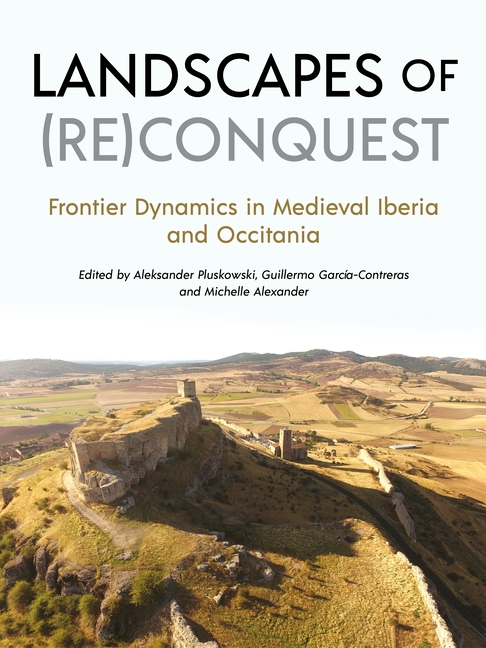
Landscapes of (Re)Conquest: Frontier Dynamics in Medieval Iberia and Occitania - Hardcover
$81.99
$95.00
-14%Quantity
01
Pay over time for orders over $35.00 with
Offers & Perks
Earn 81 points with this purchase
Added to your rewards balance after checkout.
100 points welcome bonus
Create an account and start with extra points.
Availability:In StockContributor:Aleksander Pluskowski, Michelle AlexanderPublish date:1/31/2026Pages:384
Languages:EnglishPublisher:Oxbow Books LimitedISBN-13:9798888570692UPC:9798888570692Book Category:Social Science, HistoryBook Subcategory:Archaeology, EuropeSize:10.95 x 8.51 x 1.11 inchesWeight:1.43Product ID:SCKX397HNE
A fresh historical and archaeological approach to examination of the societies of medieval Iberia.
Frontiers were an integral feature of every medieval polity, and their spaces were defined by opposing spheres of influence, contact and connectivity. As these polities expanded and contracted, often as a result of military conquest and territorial annexation, their permeable edges became defi ned by transformative cultural landscapes. Here, the encounters between resident and incoming populations, from small elite groups through to larger numbers of migrants from diverse social backgrounds, resulted in varying degrees of cultural hybridity. This came to define frontier societies, and left an enduring impact even as borderlands continued to move. These dynamic regions also saw the reconfiguration of political, economic and religious landscapes as frontier authorities invested in both old and new centres, with varying degrees of continuity. Today, the remains of their fortified residences represent the most striking monuments associated with former frontiers. They remain at the centre of public narratives regarding state formation and cultural conflict.
Adopting the definition of frontiers as both the spaces at the edges of polities and the composite societies resulting from their territorial expansion, this book presents a multi-disciplinary study of their dynamics. Focusing on the western Mediterranean, it draws on case studies of cultural landscapes shaped by two contrasting periods of conquest, regime change and state formation: the Castilian and Aragonese conquests of al-Andalus (Islamic Iberia) and the French annexation of Occitania following the Albigensian Crusade. Integrating perspectives from settlement and landscape archaeology, geoarchaeology, zooarchaeology, archaeobotany, archaeometallurgy and isotopic analyses, this book provides a new framework for the study of the transformative spaces of medieval frontier societies.
Frontiers were an integral feature of every medieval polity, and their spaces were defined by opposing spheres of influence, contact and connectivity. As these polities expanded and contracted, often as a result of military conquest and territorial annexation, their permeable edges became defi ned by transformative cultural landscapes. Here, the encounters between resident and incoming populations, from small elite groups through to larger numbers of migrants from diverse social backgrounds, resulted in varying degrees of cultural hybridity. This came to define frontier societies, and left an enduring impact even as borderlands continued to move. These dynamic regions also saw the reconfiguration of political, economic and religious landscapes as frontier authorities invested in both old and new centres, with varying degrees of continuity. Today, the remains of their fortified residences represent the most striking monuments associated with former frontiers. They remain at the centre of public narratives regarding state formation and cultural conflict.
Adopting the definition of frontiers as both the spaces at the edges of polities and the composite societies resulting from their territorial expansion, this book presents a multi-disciplinary study of their dynamics. Focusing on the western Mediterranean, it draws on case studies of cultural landscapes shaped by two contrasting periods of conquest, regime change and state formation: the Castilian and Aragonese conquests of al-Andalus (Islamic Iberia) and the French annexation of Occitania following the Albigensian Crusade. Integrating perspectives from settlement and landscape archaeology, geoarchaeology, zooarchaeology, archaeobotany, archaeometallurgy and isotopic analyses, this book provides a new framework for the study of the transformative spaces of medieval frontier societies.
Languages:EnglishPublisher:Oxbow Books LimitedISBN-13:9798888570692UPC:9798888570692Book Category:Social Science, HistoryBook Subcategory:Archaeology, EuropeSize:10.95 x 8.51 x 1.11 inchesWeight:1.43Product ID:SCKX397HNE
García-Contreras, Guillermo: - Guillermo García-Contreras is Profesor Contratado Doctor Indefinido at the University of Granada. He completed his PhD at Granada in 2013. His main research interests include the archaeology of al-Andalus, feudalism in Iberia and cultural landscapes.Alexander, Michelle: - Michelle Alexander is Professor of Bioarchaeology at the University of York. She completed her PhD at Durham University in 2010. Her main research interests include isotopic and biomolecular analyses, food culture and multi-faith and multicultural societies in the medieval Mediterranean.Pluskowski, Aleksander: - Aleks Pluskowski is Professor of Medieval Archaeology at the University of Reading, UK. He completed his PhD at the University of Cambridge in 2003. His main research interests include environmental archaeology, frontier societies and religious transformation in medieval Europe.
Publisher: Oxbow Books Limited
Contributor(s)
Free shipping on orders over $75. Standard shipping takes 3-7 business days. Eligible items may be returned within 30 days of delivery. Conditions apply.