
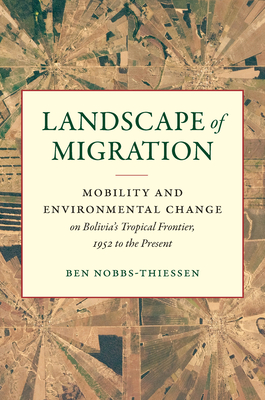
Landscape of Migration: Mobility and Environmental Change on Bolivia's Tropical Frontier, 1952 to the Present - Hardcover
$115.99
Choose Option
Hardcover
$115.99
$105.00

Paperback
$40.99
Quantity
01
Pay over time for orders over $35.00 with
Offers & Perks
Earn 115 points with this purchase
Added to your rewards balance after checkout.
100 points welcome bonus
Create an account and start with extra points.
Availability:In StockContributor:Ben Nobbs-ThiessenSeries:Flows, Migrations, and ExchangesTheme:Cultural Region/Latin AmericaPublish date:4/13/2020Pages:342
Languages:EnglishPublisher:University of North Carolina PressISBN-13:9781469656090ISBN-10:1469656094UPC:9781469656090Book Category:Science, History, Social ScienceBook Subcategory:Environmental Science, Latin America, Human GeographyBook Topic:South AmericaSize:9.21 x 6.14 x 0.88 inchesWeight:0.704Product ID:SC4M8AWBKW
In the wake of a 1952 revolution, leaders of Bolivia's National Revolutionary Movement (MNR) embarked on a program of internal colonization known as the "March to the East." In an impoverished country dependent on highland mining, the MNR sought to convert the nation's vast "undeveloped" Amazonian frontier into farmland, hoping to achieve food security, territorial integrity, and demographic balance. To do so, they encouraged hundreds of thousands of Indigenous Bolivians to relocate from the "overcrowded" Andes to the tropical lowlands, but also welcomed surprising transnational migrant streams, including horse-and-buggy Mennonites from Mexico and displaced Okinawans from across the Pacific.
Ben Nobbs-Thiessen details the multifaceted results of these migrations on the environment of the South American interior. As he reveals, one of the "migrants" with the greatest impact was the soybean, which Bolivia embraced as a profitable cash crop while eschewing earlier goals of food security, creating a new model for extractive export agriculture. Half a century of colonization would transform the small regional capital of Santa Cruz de la Sierra into Bolivia's largest city, and the diverging stories of Andean, Mennonite, and Okinawan migrants complicate our understandings of tradition, modernity, foreignness, and belonging in the heart of a rising agro-industrial empire.
Ben Nobbs-Thiessen details the multifaceted results of these migrations on the environment of the South American interior. As he reveals, one of the "migrants" with the greatest impact was the soybean, which Bolivia embraced as a profitable cash crop while eschewing earlier goals of food security, creating a new model for extractive export agriculture. Half a century of colonization would transform the small regional capital of Santa Cruz de la Sierra into Bolivia's largest city, and the diverging stories of Andean, Mennonite, and Okinawan migrants complicate our understandings of tradition, modernity, foreignness, and belonging in the heart of a rising agro-industrial empire.
Languages:EnglishPublisher:University of North Carolina PressISBN-13:9781469656090ISBN-10:1469656094UPC:9781469656090Book Category:Science, History, Social ScienceBook Subcategory:Environmental Science, Latin America, Human GeographyBook Topic:South AmericaSize:9.21 x 6.14 x 0.88 inchesWeight:0.704Product ID:SC4M8AWBKW
Nobbs-Thiessen, Ben: - Ben Nobbs-Thiessen is the chair in Mennonite studies and assistant professor of history at the University of Winnipeg.
Publisher: University of North Carolina Press
Contributor(s)
Author
Free shipping on orders over $75. Standard shipping takes 3-7 business days. Eligible items may be returned within 30 days of delivery. Conditions apply.