
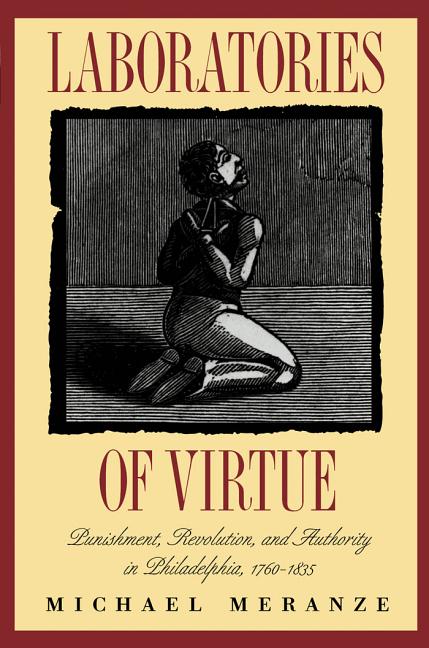
Laboratories of Virtue: Punishment, Revolution, and Authority in Philadelphia, 1760-1835 - Paperback
$48.99
Quantity
01
Pay over time for orders over $35.00 with
Offers & Perks
Earn 48 points with this purchase
Added to your rewards balance after checkout.
100 points welcome bonus
Create an account and start with extra points.
Availability:In StockContributor:Michael MeranzeSeries:Published by the Omohundro Institute of Early American HistoTheme:Chronological Period/18th Century, Cultural Region/Mid-Atlantic, Cultural Region/Midwest, Geographic Orientation/PennsylvaniaPublish date:4/29/1996Pages:352
Languages:EnglishPublisher:Omohundro Institute and Unc PressISBN-13:9780807856314ISBN-10:0807856312UPC:9780807856314Book Category:Social Science, HistoryBook Subcategory:Penology, United StatesBook Topic:Revolutionary Period (1775-1800)Size:9.21 x 6.14 x 0.79 inchesWeight:0.545Product ID:SCW9HDM8NA
Michael Meranze uses Philadelphia as a case study to analyze the relationship between penal reform and liberalism in early America. In Laboratories of Virtue, he interprets the evolving system of criminal punishment as a microcosm of social tensions that characterized the early American republic. Engaging recent work on the history of punishment in England and continental Europe, Meranze traces criminal punishment from the late colonial system of publicly inflicted corporal penalties to the establishment of penitentiaries in the Jacksonian period. Throughout, he reveals a world of class difference and contested values in which those who did not fit the emerging bourgeois ethos were disciplined and eventually segregated.
By focusing attention on the system of public penal labor that developed in the 1780s, Meranze effectively links penal reform to the development of republican principles in the Revolutionary era. His study, richly informed by Foucaultian and Freudian theory, departs from recent scholarship that treats penal reform as a nostalgic effort to reestablish social stability. Instead, Meranze interprets the reform of punishment as a forward-looking project. He argues that the new disciplinary practices arose from the reformers' struggle to contain or eliminate contradictions to their vision of an enlightened, liberal republic.
By focusing attention on the system of public penal labor that developed in the 1780s, Meranze effectively links penal reform to the development of republican principles in the Revolutionary era. His study, richly informed by Foucaultian and Freudian theory, departs from recent scholarship that treats penal reform as a nostalgic effort to reestablish social stability. Instead, Meranze interprets the reform of punishment as a forward-looking project. He argues that the new disciplinary practices arose from the reformers' struggle to contain or eliminate contradictions to their vision of an enlightened, liberal republic.
Languages:EnglishPublisher:Omohundro Institute and Unc PressISBN-13:9780807856314ISBN-10:0807856312UPC:9780807856314Book Category:Social Science, HistoryBook Subcategory:Penology, United StatesBook Topic:Revolutionary Period (1775-1800)Size:9.21 x 6.14 x 0.79 inchesWeight:0.545Product ID:SCW9HDM8NA
Michael Meranze, associate professor of history at the University of California, San Diego, is editor of Benjamin Rush's Essays: Literary, Moral, and Philosophical.
Publisher: Omohundro Institute and Unc Press
Edition
2nd Edition
Contributor(s)
Author
Free shipping on orders over $75. Standard shipping takes 3-7 business days. Eligible items may be returned within 30 days of delivery. Conditions apply.