
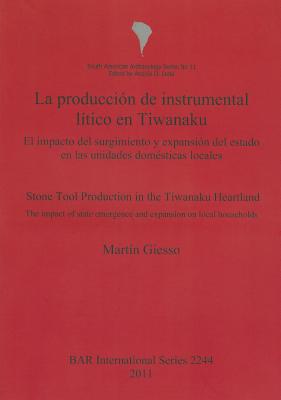
La producción de instrumental lítico en Tiwanaku / Stone Tool Production in the Tiwanaku Heartland: El impacto del surgimiento y expansión del estado - Paperback
Pay over time for orders over $35.00 with
Offers & Perks
Earn 110 points with this purchase
Added to your rewards balance after checkout.
100 points welcome bonus
Create an account and start with extra points.
South American Archaeology Series No 11
This research explores the characteristics of stone tool production in the heart of the Andean state of Tiwanaku, comparing tool production on urban and rural settlements and at elite and non-elite sites. Models of the Tiwanaku state are tested, and comparisons with the contemporaneous Wari state are explored. No evidence of craft specialization was recovered from urban or rural sites. The author demonstrates that there was an overall continuity in lithic production from the Formative (1500 B.C. - 400 A.D.) to Middle Horizon (400-1100 A.D.), but significant changes occured after 600 A.D., as exotic raw materials began to be exploited. The state controlled the procurement and distribution of obsidian and black basalt, giving preference to urban dwellers, following the experiences of earlier altiplano polities (the Pukara, Chiripa and Wankarani). At the same time, local groups procured smaller quantities of exotics from other (non-state controlled) sources. Projectile points were locally manufactured and were used in inter-group conflicts.
Author
Free shipping on orders over $75. Standard shipping takes 3-7 business days. Eligible items may be returned within 30 days of delivery. Conditions apply.