
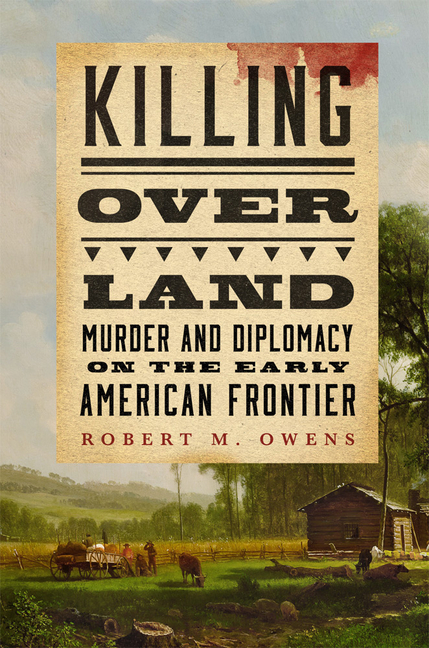
Killing Over Land: Murder and Diplomacy on the Early American Frontier - Paperback
$32.99
Choose Option
Paperback
$32.99
$29.95

Killing Over Land: Murder and Diplomacy on the Early American Frontier
$49.99
Quantity
01
Pay over time for orders over $35.00 with
Offers & Perks
Earn 32 points with this purchase
Added to your rewards balance after checkout.
100 points welcome bonus
Create an account and start with extra points.
Availability:In StockContributor:Robert M. OwensTheme:Chronological Period/18th Century, Cultural Region/MidwestPublish date:4/14/2026Pages:266
Languages:EnglishPublisher:University of Oklahoma PressISBN-13:9780806196893ISBN-10:0806196890UPC:9780806196893Book Category:HistoryBook Subcategory:United States, IndigenousBook Topic:Colonial Period (1600-1775), Revolutionary Period (1775-1800)Size:9.00 x 6.00 x 0.60 inchesWeight:0.359Product ID:SC9ZDMBTRK
In early America, interracial homicide--whites killing Native Americans, Native Americans killing whites--might result in a massive war on the frontier; or, if properly mediated, it might actually facilitate diplomatic relations, at least for a time. In Killing over Land, Robert M. Owens explores why and how such murders once played a key role in Indian affairs and how this role changed over time. Though sometimes clearly committed to stoke racial animus and incite war, interracial murder also gave both Native and white leaders an opportunity to improve relations, or at least profit from conflict resolution. In the seventeenth century, most Indigenous people held and used enough leverage to dictate the terms on which such conflicts were resolved; but after the mid-eighteenth century, population and material advantages gave white settlers the upper hand. Owens describes the ways settler colonialism, as practiced by Anglo-Americans, put tremendous pressure on Native peoples, culturally, socially, and politically, forcing them to adapt in the face of violence and overwhelming numbers. By the early nineteenth century, many Native leaders recognized that, with population and power so heavily skewed against them, it was only practical to negotiate for the best possible terms; lex talionis justice--blood for blood--proved an unrealistic goal. Consequently, Indigenous and white leaders alike became all too willing to overlook murder if it led to some kind of gain--if, for instance, justice might be traded for financial compensation or land cessions. Ultimately, what Owens analyzes in Killing over Land is nothing less than the commodification of human life in return for a sense of order--as defined and accepted, however differently, by both Native and white authorities as the contest for land and resources intensified in the European colonization of North America.
Languages:EnglishPublisher:University of Oklahoma PressISBN-13:9780806196893ISBN-10:0806196890UPC:9780806196893Book Category:HistoryBook Subcategory:United States, IndigenousBook Topic:Colonial Period (1600-1775), Revolutionary Period (1775-1800)Size:9.00 x 6.00 x 0.60 inchesWeight:0.359Product ID:SC9ZDMBTRK
Free shipping on orders over $75. Standard shipping takes 3-7 business days. Returns accepted within 30 days of purchase.