
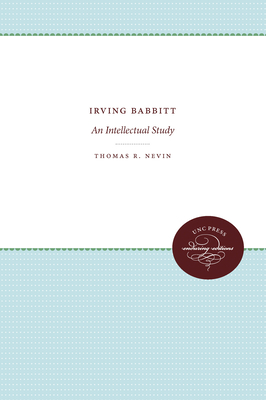
Irving Babbitt: An Intellectual Study - Paperback
$51.99
$52.50
-1%Quantity
01
Pay over time for orders over $35.00 with
Offers & Perks
Earn 51 points with this purchase
Added to your rewards balance after checkout.
100 points welcome bonus
Create an account and start with extra points.
Languages:EnglishPublisher:University of North Carolina PressISBN-13:9780807836293ISBN-10:080783629XUPC:9780807836293Book Category:Philosophy, Biography & AutobiographyBook Subcategory:History & SurveysBook Topic:ModernSize:9.00 x 6.00 x 0.48 inchesWeight:0.313Product ID:SCKHAT5MFY
Few men in America's intellectual history have sought as much as Irving Babbitt to be a crucible for the cultural values that America, expecially in its "progressive" epoch, had no inclination to receive. Over sixty years after his death, Babbitt remains a figure of controversy. He retains his reputation as a reactionary defender of genteel morality and taste, yet, as Thomas Nevin reminds us, he continues to be a scholar of importance and an erudite, forceful teacher who influenced -- among others -- T. S. Eliot, Van Wyck Brooks, Walter Lippmann, Austin Warren, and David Riesman.
Nevin argues that the tradition Babbit represented did not so much uphold class mores as it urged that literature embody and inculcate discipline. In this book-length study of Babbitt's humanism, Nevin examines the controversial critic's attacks on collegiate educational reform, his literary and aesthetic criticism, his political philosophy of an "aristocratic democracy" and his fusion of humanism with Buddhism. Included in each chapter are substantial portions of Babbitt's unpublished correspondence with Paul Elmer More, letters that eloquently reveal points of agreement and difference between Babbitt's humanism and the theism that More came to espouse.
Although this study reflects the variety of Babbitt's concerns, it concentrates on his major ideas: the need to maintain the dualism that is the legacy of the Western philosophical tradition, the imperative that critically sound standards of judgment be maintained in the individual and in society, and the affirmation of the human will against the reductive forces of materialistic ideologies. Humanism, as Babbitt defines it, opposes the ascendance of utilitarian science because the sciences, however legitimate in the area of phenomenal inquiry, as a secular faith supplant the traditional strength and appeal of cultural and religious standards. Literature itself under the influence of naturalism either reflects a mechanized, demoralized society or merely escapes aesthetically from its ugliness.
With the reprinting of some of Babbitt's writings, scholars may now reassess his thought. Irving Babbitt should renew interest in a major American thinker and vindicate many of his arguments that apply to the problems of our own day.
Originally published in 1984.
A UNC Press Enduring Edition -- UNC Press Enduring Editions use the latest in digital technology to make available again books from our distinguished backlist that were previously out of print. These editions are published unaltered from the original, and are presented in affordable paperback formats, bringing readers both historical and cultural value.
Nevin argues that the tradition Babbit represented did not so much uphold class mores as it urged that literature embody and inculcate discipline. In this book-length study of Babbitt's humanism, Nevin examines the controversial critic's attacks on collegiate educational reform, his literary and aesthetic criticism, his political philosophy of an "aristocratic democracy" and his fusion of humanism with Buddhism. Included in each chapter are substantial portions of Babbitt's unpublished correspondence with Paul Elmer More, letters that eloquently reveal points of agreement and difference between Babbitt's humanism and the theism that More came to espouse.
Although this study reflects the variety of Babbitt's concerns, it concentrates on his major ideas: the need to maintain the dualism that is the legacy of the Western philosophical tradition, the imperative that critically sound standards of judgment be maintained in the individual and in society, and the affirmation of the human will against the reductive forces of materialistic ideologies. Humanism, as Babbitt defines it, opposes the ascendance of utilitarian science because the sciences, however legitimate in the area of phenomenal inquiry, as a secular faith supplant the traditional strength and appeal of cultural and religious standards. Literature itself under the influence of naturalism either reflects a mechanized, demoralized society or merely escapes aesthetically from its ugliness.
With the reprinting of some of Babbitt's writings, scholars may now reassess his thought. Irving Babbitt should renew interest in a major American thinker and vindicate many of his arguments that apply to the problems of our own day.
Originally published in 1984.
A UNC Press Enduring Edition -- UNC Press Enduring Editions use the latest in digital technology to make available again books from our distinguished backlist that were previously out of print. These editions are published unaltered from the original, and are presented in affordable paperback formats, bringing readers both historical and cultural value.
Languages:EnglishPublisher:University of North Carolina PressISBN-13:9780807836293ISBN-10:080783629XUPC:9780807836293Book Category:Philosophy, Biography & AutobiographyBook Subcategory:History & SurveysBook Topic:ModernSize:9.00 x 6.00 x 0.48 inchesWeight:0.313Product ID:SCKHAT5MFY
Thomas R. Nevin is author of Simone Weil: Portrait of a Self-Exiled Jew.
Publisher: University of North Carolina Press
Contributor(s)
Author
Free shipping on orders over $75. Standard shipping takes 3-7 business days. Eligible items may be returned within 30 days of delivery. Conditions apply.