
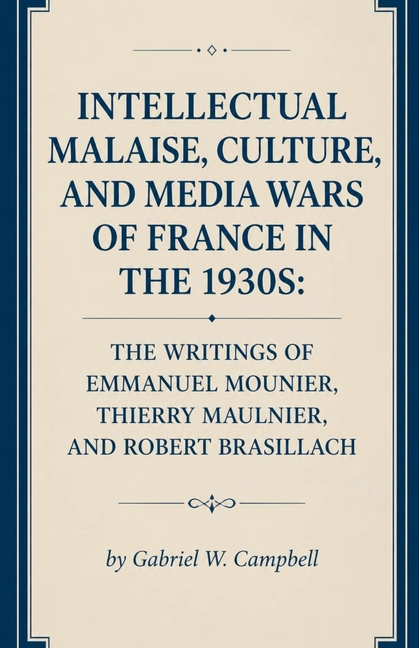
Intellectual Malaise, Culture, and Media Wars of France in the 1930s: The Writings of Emmanuel Mounier, Thierry Maulnier, and Robert Brasillach - Paperback
Pay over time for orders over $35.00 with
Offers & Perks
Earn 15 points with this purchase
Added to your rewards balance after checkout.
100 points welcome bonus
Create an account and start with extra points.
In the autumn of 1931, the economic tremors that had shattered Wall Street two years prior finally breached the fiscal ramparts of the French Third Republic. For nearly two decades, French political elites had comforted themselves with the illusion of a unique national immunity, persuaded that the nation's balanced equilibrium between industry and agriculture, alongside its stoic republican institutions, would shield it from the structural convulsions tearing through Anglo-Saxon capitalism and Central European democracies. When the collapse arrived, it did not merely dismantle financial markets; it struck a society already paralyzed by an insidious, pervasive sense of spiritual and cultural exhaustion. The interwar era in France was defined less by its material deprivation than by a profound crisis of faith in the foundational tenets of Enlightenment rationalism, bourgeois liberalism, and parliamentary democracy. A pervasive conviction took hold across the cultural spectrum that the republic was no longer merely misgoverned, but irrevocably corrupt, intellectually bankrupt, and structurally decadent. This delusion of inevitable decadence-the pervasive obsession with la décadence-became the organizing myth of a generation of intellectuals who came of age in the shadow of the Great War.
This book situates itself directly within this dynamic historiographical landscape, offering a comparative intellectual biography of Mounier, Maulnier, and Brasillach to trace how a shared cultural diagnosis disintegrated under the weight of historical events. By examining these three thinkers side by side across twenty-one substantive thematic chapters, this volume demonstrates that the political polarization of the 1930s was not merely driven by external economic shocks or party-political machinations, but by an internal, highly sophisticated media war fought in the pages of books, journals, and newspapers. The decade was defined by a series of escalating historical flashpoints that systematically forced intellectuals to abandon nuanced theoretical positions and adopt uncompromising political postures.
Free shipping on orders over $75. Standard shipping takes 3-7 business days. Eligible items may be returned within 30 days of delivery. Conditions apply.