
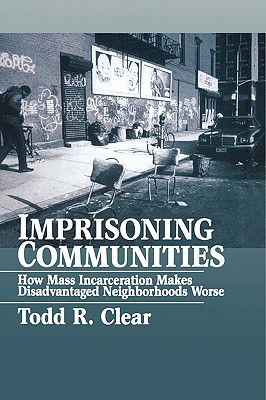
Imprisoning Communities: How Mass Incarceration Makes Disadvantaged Neighborhoods Worse - Hardcover
$120.99
Quantity
01
Pay over time for orders over $35.00 with
Offers & Perks
Earn 120 points with this purchase
Added to your rewards balance after checkout.
100 points welcome bonus
Create an account and start with extra points.
Availability:In StockContributor:Todd R. ClearSeries:Studies in Crime and Public PolicyTheme:Demographic Orientation/UrbanPublish date:7/30/2007Pages:280
Languages:EnglishPublisher:Oxford University PressISBN-13:9780195305791ISBN-10:0195305795UPC:9780195305791Book Category:Social ScienceBook Subcategory:Criminology, Sociology, Poverty & HomelessnessBook Topic:UrbanSize:9.33 x 6.45 x 0.93 inchesWeight:0.54Product ID:SCN9JWY7NC
At no time in history, and certainly in no other democratic society, have prisons been filled so quickly and to such capacity than in the United States. And nowhere has this growth been more concentrated than in the disadvantaged--and primarily minority--neighborhoods of America's largest urban cities. In the most impoverished places, as much as 20% of the adult men are locked up on any given day, and there is hardly a family without a father, son, brother, or uncle who has not been behind bars. While the effects of going to and returning home from prison are well-documented, little attention has been paid to the impact of removal on neighborhoods where large numbers of individuals have been imprisoned. In the first detailed, empirical exploration of the effects of mass incarceration on poor places, Imprisoning Communities demonstrates that in high doses incarceration contributes to the very social problems it is intended to solve: it breaks up family and social networks; deprives siblings, spouses, and parents of emotional and financial support; and threatens the economic and political infrastructure of already struggling neighborhoods. Especially at risk are children who, research shows, are more likely to commit a crime if a father or brother has been to prison. Clear makes the counterintuitive point that when incarceration concentrates at high levels, crime rates will go up. Removal, in other words, has exactly the opposite of its intended effect: it destabilizes the community, thus further reducing public safety. Demonstrating that the current incarceration policy in urban America does more harm than good, from increasing crime to widening racial disparities and diminished life chances for youths, Todd Clear argues that we cannot overcome the problem of mass incarceration concentrated in poor places without incorporating an idea of community justice into our failing correctional and criminal justice systems.
Languages:EnglishPublisher:Oxford University PressISBN-13:9780195305791ISBN-10:0195305795UPC:9780195305791Book Category:Social ScienceBook Subcategory:Criminology, Sociology, Poverty & HomelessnessBook Topic:UrbanSize:9.33 x 6.45 x 0.93 inchesWeight:0.54Product ID:SCN9JWY7NC
Todd R. Clear is a Distinguished Professor at John Jay College of Criminal Justice, City University of New York, and founding editor of the journal Criminology & Public Policy. He is the author of eleven books and numerous articles and book chapters on criminal justice issues ranging from corrections and sentencing to community justice.
Publisher: Oxford University Press
Contributor(s)
Author
Free shipping on orders over $75. Standard shipping takes 3-7 business days. Returns accepted within 30 days of purchase.