
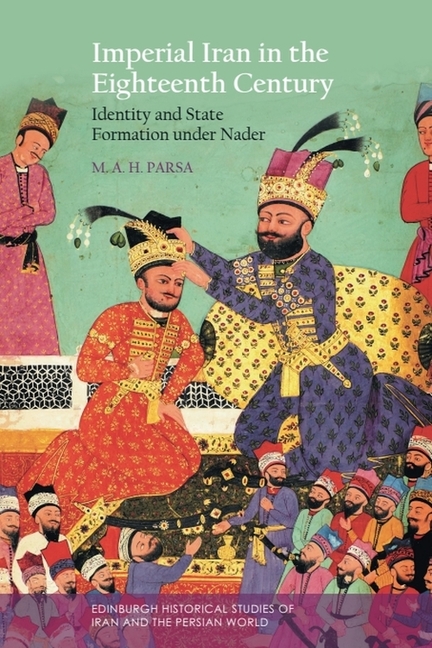
Imperial Iran in the Eighteenth Century: Identity and State Formation Under Nader - Hardcover
Pay over time for orders over $35.00 with
Offers & Perks
Earn 146 points with this purchase
Added to your rewards balance after checkout.
100 points welcome bonus
Create an account and start with extra points.
The 18th-century 'interregnum' between the Safavid and Qajar dynasties remains woefully understudied in Iranian history, regarded as a turbulent and inconsequential gap between two major dynastic periods. This book, however, argues that this period saw the emergence of the idea of Iran as the foundation for collective identity and state formation. It traces the development of a sacralised territorial identity that fused an irredentist notion of Iran-realm (Iranzamin) with Shiʿism, culminating in an unprecedented political idea: that of an 'Iranian state' (dowlat-e Irān), supposedly formed by the unanimous consensus of the 'Iranian people' (ahl-e Irān). The book then covers how this state, under Nader Shah (Nāder-e Irān), subjugated non-Iranian realms to form a new universal Islamic empire.
This is the first monograph to offer an integrated understanding of state formation in post-Safavid Iran (c.1720 - 1750), demonstrating how politico-cultural, military, administrative and ecclesiastic developments related to one another. Drawing on a wide range of neglected primary sources in Arabic, Turkish (both Ajami and Ottoman) and Kurdish (Hawrami), as well as Persian and European sources, the book sheds light on Iran in its last iteration as a great power.Contributor(s)
Free shipping on orders over $75. Standard shipping takes 3-7 business days. Eligible items may be returned within 30 days of delivery. Conditions apply.