
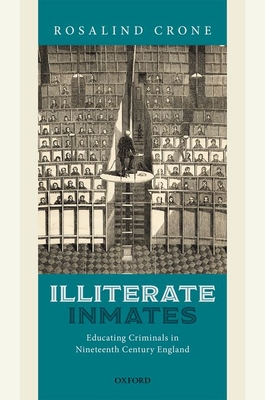
Illiterate Inmates: Educating Criminals in Nineteenth Century England - Hardcover
$161.99
Quantity
01
Pay over time for orders over $35.00 with
Offers & Perks
Earn 161 points with this purchase
Added to your rewards balance after checkout.
100 points welcome bonus
Create an account and start with extra points.
Availability:In StockContributor:Rosalind CroneTheme:Chronological Period/19th Century, Chronological Period/Modern, Cultural Region/BritishPublish date:8/12/2022Pages:452
Languages:EnglishPublisher:Oxford University PressISBN-13:9780198833833ISBN-10:0198833830UPC:9780198833833Book Category:Education, HistoryBook Subcategory:History, Modern, EuropeBook Topic:Great BritainSize:9.57 x 6.51 x 1.29 inchesWeight:0.872Product ID:SCD1HE66J2
The nineteenth-century prison, we have been told, was a place of 'hard labour, hard board, and hard fare'. Yet it was also a place of education. Schemes to teach prisoners to read and write, and sometimes more besides, can be traced to the early 1800s. State-funded elementary education for prisoners pre-dated universal and compulsory education for children by fifty years. In the 1860s, when the famous maxim, just cited, became the basis of national penal policy, arithmetic was included by legislators alongside reading and writing as a core skill to be taught in English prisons. By c.1880 every prison in England used to accommodate those convicted of criminal offences had a formal education programme in which the 3Rs - reading, writing, and arithmetic - were taught, to males and females, adults and children alike. Not every programme, however, had prisoners enrolled in it. Illiterate Inmates tells the story of the emergence, at the turn of the nineteenth century, of a powerful idea - the provision of education in prisons for those accused and convicted of crime - and its execution over the century that followed. Using evidence from both local and convict prisons, the study shows how education became part of the modern penal regime. While the curriculum largely reflected that of mainstream elementary schools, the delivery of education, shaped by the penal environment, created an entirely different educational experience. At the same time, philosophies of imprisonment which prioritised punishment and deterrence over reformation undermined any socially reconstructive ambitions. Thus the period between 1800 and 1899 witnessed the rise and fall of the prison school in England.
Languages:EnglishPublisher:Oxford University PressISBN-13:9780198833833ISBN-10:0198833830UPC:9780198833833Book Category:Education, HistoryBook Subcategory:History, Modern, EuropeBook Topic:Great BritainSize:9.57 x 6.51 x 1.29 inchesWeight:0.872Product ID:SCD1HE66J2
Rosalind Crone, Senior Lecturer in History, The Open University Rosalind Crone is senior lecturer in history at The Open University, author of Violent Victorians (2012) and has written on nineteenth-century popular culture, the history of reading, literacy and education, and the history of prisons. She is Director of the Open University's Centre for the History of Crime, Policing, and Justice and project lead for prisonhistory.org.
Publisher: Oxford University Press
Contributor(s)
Author
Free shipping on orders over $75. Standard shipping takes 3-7 business days. Eligible items may be returned within 30 days of delivery. Conditions apply.