
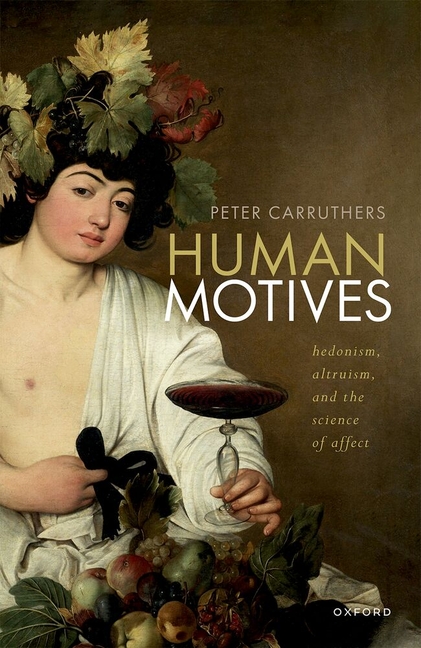
Human Motives: Hedonism, Altruism, and the Science of Affect - Paperback
$26.99
Choose Option
Paperback
$26.99
$25.00

Human Motives: Hedonism, Altruism, and the Science of Affect
$44.99
Quantity
01
Pay over time for orders over $35.00 with
Offers & Perks
Earn 26 points with this purchase
Added to your rewards balance after checkout.
100 points welcome bonus
Create an account and start with extra points.
Languages:EnglishPublisher:Oxford University Press (UK)ISBN-13:9780197918630ISBN-10:0197918638UPC:9780197918630Book Category:Philosophy, PsychologyBook Subcategory:Ethics & Moral Philosophy, Mind & BodySize:9.21 x 6.14 x 0.49 inchesWeight:0.331Product ID:SCHD2QCKVT
Motivational hedonism (often called "psychological hedonism") claims that everything we do is done in pursuit of pleasure (in the widest sense) and to avoid pain and displeasure (again, in the widest sense). Although perennially attractive, many philosophers and experimental psychologists have claimed to refute it. Human Motives shows how decision-science and the recent science of affect can be used to construct a form of motivational hedonism that evades all previous critiques. On this view, we take decisions by anticipating and responding affectively to the alternatives, with the pleasure/displeasure component of affect constituting the common currency of decision-making. But we do not have to believe that the alternatives will bring us pleasure or displeasure in the future. Rather, those feelings get bound into and become parts of the future-directed representation of the options, rendering the latter attractive or repulsive. Much then depends on what pleasure and displeasure really are. If they are intrinsically good or bad properties of experience, for example, then motivational hedonism results. Carruthers argues, in contrast, that the best account is a representational one: pleasure represents its object (nonconceptually, in a perception-like manner) as good, and displeasure represents it (nonconceptually) as bad. The result is pluralism about human motivation, making room for both genuine altruism and intrinsic motives of duty. Clearly written and deeply scientifically informed, Human Motives has implications for many areas of philosophy and cognitive science, and will be of interest to anyone wanting to understand the foundations of human motivation.
Languages:EnglishPublisher:Oxford University Press (UK)ISBN-13:9780197918630ISBN-10:0197918638UPC:9780197918630Book Category:Philosophy, PsychologyBook Subcategory:Ethics & Moral Philosophy, Mind & BodySize:9.21 x 6.14 x 0.49 inchesWeight:0.331Product ID:SCHD2QCKVT
Peter Carruthers, Distinguished University Professor of Philosophy, University of Maryland Peter Carruthers is Distinguished University Professor of philosophy at the University of Maryland, where he has worked since 2001. He previously held appointments at a number of universities in the UK. He has published widely across many areas of philosophy of mind and cognitive science, including work on cognitive architecture, the role of language in thought, selfknowledge, consciousness, the mentality of animals, and meta-cognition. His most recent books are Human and Animal Minds: The Consciousness Questions Laid to Rest (2019) and Explaining our Actions: A Critique of Common-Sense Theorizing (2025).
Publisher: Oxford University Press (UK)
Contributor(s)
Author
Free shipping on orders over $75. Standard shipping takes 3-7 business days. Returns accepted within 30 days of purchase.