
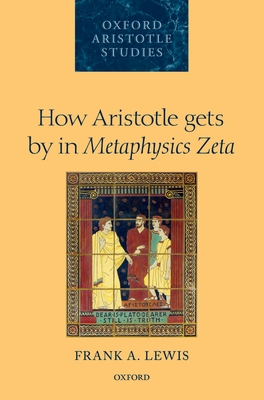
How Aristotle Gets by in Metaphysics Zeta - Hardcover
$156.99
Quantity
01
Pay over time for orders over $35.00 with
Offers & Perks
Earn 156 points with this purchase
Added to your rewards balance after checkout.
100 points welcome bonus
Create an account and start with extra points.
Availability:In StockContributor:Frank A. LewisSeries:Oxford Aristotle StudiesTheme:Chronological Period/Ancient (To 499 A.D.), Interdisciplinary Studies/ClassicsPublish date:8/24/2013Pages:342
Languages:EnglishPublisher:Oxford University PressISBN-13:9780199664016ISBN-10:0199664013UPC:9780199664016Book Category:PhilosophyBook Subcategory:History & SurveysBook Topic:Ancient & ClassicalSize:9.20 x 6.10 x 1.10 inchesWeight:0.681Product ID:SCN8YKS3GD
Frank A. Lewis presents a closely argued exposition of Metaphysics Zeta--one of Aristotle's most dense and controversial texts. It is commonly understood to contain Aristotle's deepest thoughts on the definition of substance and surrounding metaphysical issues. But people have increasingly come to recognize how little Aristotle says in Zeta about his own theory of (Aristotelian) form and matter. Instead, he spends the bulk of the book examining 'received opinions', often as filtered through his own Organon, but including above all the views of Plato, who is at times friend, and at times foe. For much of the time, we are left to reconstruct Aristotle's finished views, subject to the constraint that they survive the critique he directs in Zeta at the philosophical tradition. In this book, Lewis argues that in giving his actual conclusion to Zeta in its final chapter, 17, Aristotle drops his earlier, largely critical engagement with received views, and turns approvingly to his own Posterior Analytics. The result is a causal view of (primary) substance, representing the property of being a (primary) substance (or the substance of a thing) as, in modern dress, the second-order functional property of (Aristotelian) forms, that they be the cause of being for different compound material substances. The property of being the cause of being for a thing is a role property, and it is realized in different forms and the sets of causal powers associated with them, matching the variety of things that have a form as their substance. Meanwhile, the failure of previous attempts at definition in earlier chapters leaves Aristotle's own definition standing as the 'best explanation' for the views proprietary to the theory of form and matter. The point that (Aristotelian) forms are the primary substances is not the main conclusion to Zeta, but rather a result his definition must give, if the definition is to be acceptable.
Languages:EnglishPublisher:Oxford University PressISBN-13:9780199664016ISBN-10:0199664013UPC:9780199664016Book Category:PhilosophyBook Subcategory:History & SurveysBook Topic:Ancient & ClassicalSize:9.20 x 6.10 x 1.10 inchesWeight:0.681Product ID:SCN8YKS3GD
Frank A. Lewis is Professor of Philosophy at the University of Southern California. He taught previously at the University of Arizona and at UCLA; he has held visiting positions at Stanford and at UCLA, and has twice held fellowships from the American Council of Learned Societies. He is the author of Substance and Predication in Aristotle (Cambridge 1991), and co-editor with R. Bolton of Form, Matter, and Mixture in Aristotle (Blackwell, 1996). Recent publications deal mostly with topics in Aristotle's metaphysics and natural philosophy.
Publisher: Oxford University Press
Contributor(s)
Author
Free shipping on orders over $75. Standard shipping takes 3-7 business days. Eligible items may be returned within 30 days of delivery. Conditions apply.