
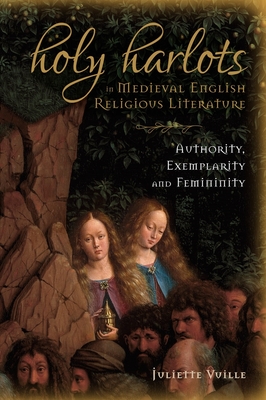
Holy Harlots in Medieval English Religious Literature: Authority, Exemplarity and Femininity - Hardcover
$135.99
Quantity
01
Pay over time for orders over $35.00 with
Offers & Perks
Earn 135 points with this purchase
Added to your rewards balance after checkout.
100 points welcome bonus
Create an account and start with extra points.
Availability:In StockContributor:Juliette VuilleSeries:Gender in the Middle AgesTheme:Chronological Period/Medieval (500-1453) Studies, Cultural Region/BritishPublish date:4/16/2021Pages:298
Languages:EnglishPublisher:Boydell & BrewerISBN-13:9781843845898ISBN-10:184384589XUPC:9781843845898Book Category:Literary Criticism, Literary CollectionsBook Subcategory:Medieval, English, Irish, Scottish, WelshSize:9.21 x 6.14 x 0.69 inchesWeight:0.595Product ID:SCR2V52PC1
First comprehensive investigation of the major significance of female sinners turned saints in medieval literature. During the Middle Ages, the lives of saints such as Mary Magdalen and Mary of Egypt - "holy harlots", women who repented of an early life of licentiousness to become blessed - were hugely popular, for both clerical and laypersons, men and women alike. These legends are rife with paradox: the saints are presented as epitomes of a type of femininity universally accepted as a model for all Christians to emulate in their quest for salvation, but at the same time they constitute marginal figures who could be petitioned in support of unconventional beliefs and lifestyles. The holy harlot's potential to contain the markers of both sainthood and whoredom within a single female body was however rejected in the sixteenth century, and so this fascinating model of sanctity has since been largely overlooked. This book, the first full-length study on the topic, aims to redress the situation, demonstrating that these apparent outliers transformed mainstream concepts of piety and womanhood. It uses the Old English Martyrology and the Old English Life of Mary of Egypt to show that the early English conceived harlots becoming saints as a move from female to queer rather than as a gender inversion. In the later Middle Ages, "holy harlot" lives in the French of England and in Middle English (including the South English Legendary, the Digby Mary Magdalene, and in lives by John Mirk and Osbern Bokenham) are shown to demonstrate the centrality, from the twelfth-century rise of affective piety, of the harlot saints' femininity as a model for Everyman. They can also be seen as an influence on the writings of such women as Christina of Markyate, Margery Kempe, and Elizabeth Barton, and key to the self-representation of Bernard of Clairvaux and the Wycliffites.
Languages:EnglishPublisher:Boydell & BrewerISBN-13:9781843845898ISBN-10:184384589XUPC:9781843845898Book Category:Literary Criticism, Literary CollectionsBook Subcategory:Medieval, English, Irish, Scottish, WelshSize:9.21 x 6.14 x 0.69 inchesWeight:0.595Product ID:SCR2V52PC1
Vuille, Juliette: - JULIETTE VUILLE is a Lecturer in Old and Middle English at the University of Lausanne.
Publisher: Boydell & Brewer
Contributor(s)
Author
Free shipping on orders over $75. Standard shipping takes 3-7 business days. Eligible items may be returned within 30 days of delivery. Conditions apply.