
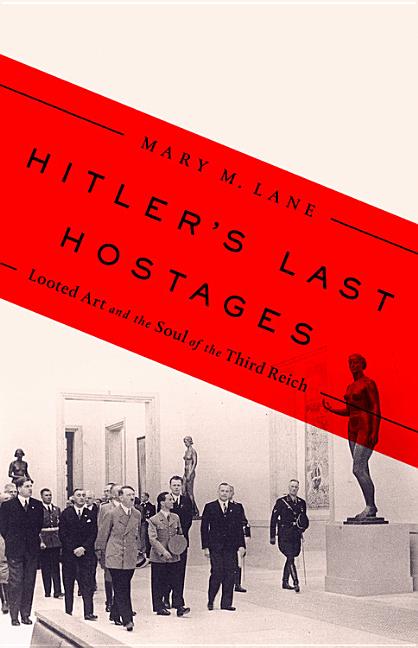
Hitler's Last Hostages: Looted Art and the Soul of the Third Reich - Hardcover
by Mary M. Lane
$27.99
$38.00
-26%Quantity
01
Pay over time for orders over $35.00 with
Offers & Perks
Earn 27 points with this purchase
Added to your rewards balance after checkout.
100 points welcome bonus
Create an account and start with extra points.
Availability:In StockContributor:Mary M. LaneTheme:Chronological Period/1940's, Chronological Period/1950-1999, Chronological Period/21st Century, Cultural Region/Germany, Ethnic Orientation/Jewish, Topical/HolocaustPublish date:9/10/2019Pages:336
Languages:EnglishPublisher:PublicAffairsISBN-13:9781610397360ISBN-10:1610397363UPC:9781610397360Book Category:History, ArtBook Subcategory:Wars & Conflicts, Europe, MovementsBook Topic:World War II, Germany, ModernismSize:9.40 x 6.10 x 1.40 inchesWeight:0.568Product ID:SC7ATME38Q
Adolf Hitler's obsession with art not only fueled his vision of a purified Nazi state--it was the core of his fascist ideology. Its aftermath lives on to this day.
Nazism ascended by brute force and by cultural tyranny. Weimar Germany was a society in turmoil, and Hitler's rise was achieved not only by harnessing the military but also by restricting artistic expression. Hitler, an artist himself, promised the dejected citizens of postwar Germany a purified Reich, purged of "degenerate" influences. When Hitler came to power in 1933, he removed so-called "degenerate" art from German society and promoted artists whom he considered the embodiment of the "Aryan ideal." Artists who had produced challenging and provocative work fled the country. Curators and art dealers organized their stock. Thousands of great artworks disappeared--and only a fraction of them were rediscovered after World War II. In 2013, the German government confiscated roughly 1,300 works by Henri Matisse, George Grosz, Claude Monet, and other masters from the apartment of Cornelius Gurlitt, the reclusive son of one of Hitler's primary art dealers. For two years, the government kept the discovery a secret. In Hitler's Last Hostages, Mary M. Lane reveals the fate of those works and tells the definitive story of art in the Third Reich and Germany's ongoing struggle to right the wrongs of the past.
Nazism ascended by brute force and by cultural tyranny. Weimar Germany was a society in turmoil, and Hitler's rise was achieved not only by harnessing the military but also by restricting artistic expression. Hitler, an artist himself, promised the dejected citizens of postwar Germany a purified Reich, purged of "degenerate" influences. When Hitler came to power in 1933, he removed so-called "degenerate" art from German society and promoted artists whom he considered the embodiment of the "Aryan ideal." Artists who had produced challenging and provocative work fled the country. Curators and art dealers organized their stock. Thousands of great artworks disappeared--and only a fraction of them were rediscovered after World War II. In 2013, the German government confiscated roughly 1,300 works by Henri Matisse, George Grosz, Claude Monet, and other masters from the apartment of Cornelius Gurlitt, the reclusive son of one of Hitler's primary art dealers. For two years, the government kept the discovery a secret. In Hitler's Last Hostages, Mary M. Lane reveals the fate of those works and tells the definitive story of art in the Third Reich and Germany's ongoing struggle to right the wrongs of the past.
Languages:EnglishPublisher:PublicAffairsISBN-13:9781610397360ISBN-10:1610397363UPC:9781610397360Book Category:History, ArtBook Subcategory:Wars & Conflicts, Europe, MovementsBook Topic:World War II, Germany, ModernismSize:9.40 x 6.10 x 1.40 inchesWeight:0.568Product ID:SC7ATME38Q
Mary M. Lane (b. 1987) is a nonfiction writer and journalist specializing in Western art, Western European history, and anti-Semitism. Lane received one of five Fulbright Journalism Scholarships at 22 years old, gained international recognition as the chief European art reporter for the Wall Street Journal, and published numerous exclusive Page One articles on the art trove of Hildebrand Gurlitt. Since leaving the Journal, Lane has been a European art contributor for the New York Times. She splits her time between Berlin and Virginia.
Publisher: PublicAffairs
Contributor(s)
Author
Free shipping on orders over $75. Standard shipping takes 3-7 business days. Returns accepted within 30 days of purchase.