
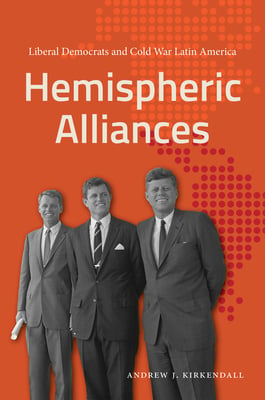
Hemispheric Alliances: Liberal Democrats and Cold War Latin America - Hardcover
$108.99
Quantity
01
Pay over time for orders over $35.00 with
Offers & Perks
Earn 108 points with this purchase
Added to your rewards balance after checkout.
100 points welcome bonus
Create an account and start with extra points.
Availability:In StockContributor:Andrew J. KirKendallTheme:Chronological Period/20th Century, Cultural Region/Latin AmericaPublish date:6/14/2022Pages:398
Languages:EnglishPublisher:University of North Carolina PressISBN-13:9781469668000ISBN-10:1469668009UPC:9781469668000Book Category:Social Science, Political Science, HistoryBook Subcategory:Cultural & Ethnic Studies, International Relations, United StatesBook Topic:Caribbean & Latin American Studies, Diplomacy, 20th CenturySize:9.21 x 6.14 x 1.00 inchesWeight:0.79Product ID:SC4WBC8YZ1
Hemispheric foreign policy has waxed and waned since the Mexican War, and the Cold War presented both extraordinary promises and dangerous threats to U.S.-Latin American cooperation. In Hemispheric Alliances, Andrew J. Kirkendall examines the strengths and weaknesses of new models for U.S.-Latin American relations created by liberal Democrats who came to the fore during the Kennedy administration and retained significant influence until the Reagan era. Rather than exerting ironfisted power in Latin America, liberal Democrats urged Washington to be a moral rather than a militaristic leader in hemispheric affairs.
Decolonization, President Eisenhower's missteps in Latin America, and the Cuban Revolution all played key roles in the Kennedy administration's Alliance for Progress, which liberal Democrats hailed as a new cornerstone for U.S.-Latin American foreign policy. During the Vietnam War era, liberal Democrats began to incorporate human rights more centrally into their agendas, using Latin America as the primary arena for these policies. During the long period of military dictatorship in much of Latin America and the Caribbean, liberal Democrats would see their policies dissolved by the Nixon, Reagan, and Bush administrations who favored militant containment of both communism and absolutism.
Decolonization, President Eisenhower's missteps in Latin America, and the Cuban Revolution all played key roles in the Kennedy administration's Alliance for Progress, which liberal Democrats hailed as a new cornerstone for U.S.-Latin American foreign policy. During the Vietnam War era, liberal Democrats began to incorporate human rights more centrally into their agendas, using Latin America as the primary arena for these policies. During the long period of military dictatorship in much of Latin America and the Caribbean, liberal Democrats would see their policies dissolved by the Nixon, Reagan, and Bush administrations who favored militant containment of both communism and absolutism.
Languages:EnglishPublisher:University of North Carolina PressISBN-13:9781469668000ISBN-10:1469668009UPC:9781469668000Book Category:Social Science, Political Science, HistoryBook Subcategory:Cultural & Ethnic Studies, International Relations, United StatesBook Topic:Caribbean & Latin American Studies, Diplomacy, 20th CenturySize:9.21 x 6.14 x 1.00 inchesWeight:0.79Product ID:SC4WBC8YZ1
KirKendall, Andrew J.: - Andrew J. Kirkendall is author of Paulo Freire and the Cold War Politics of Literacy.
Publisher: University of North Carolina Press
Contributor(s)
Author
Free shipping on orders over $75. Standard shipping takes 3-7 business days. Eligible items may be returned within 30 days of delivery. Conditions apply.