
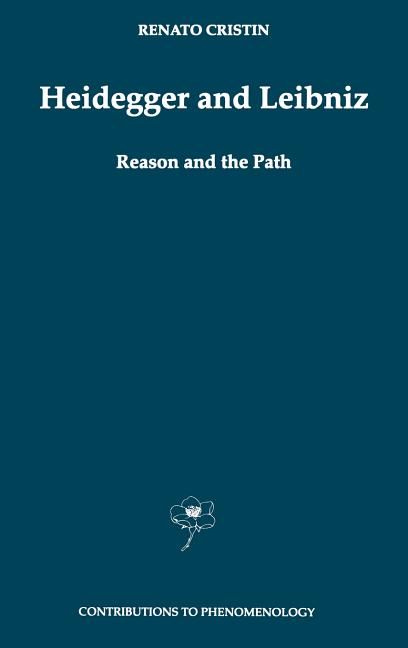
Heidegger and Leibniz: Reason and the Path with a Foreword by Hans Georg Gadamer - Hardcover
by R. Cristin
$108.99
$109.99
-1%Quantity
01
Pay over time for orders over $35.00 with
Offers & Perks
Earn 108 points with this purchase
Added to your rewards balance after checkout.
100 points welcome bonus
Create an account and start with extra points.
Availability:In StockContributor:R. Cristin, Gerald ParksSeries:Contributions to PhenomenologyTheme:Chronological Period/ModernPublish date:7/31/1998Pages:136
Languages:EnglishPublisher:SpringerISBN-13:9780792351375ISBN-10:0792351371UPC:9780792351375Book Category:PhilosophyBook Subcategory:History & Surveys, Metaphysics, MovementsBook Topic:Modern, PhenomenologySize:9.76 x 6.60 x 0.77 inchesWeight:0.445Product ID:SCHTGRC5W0
Heidegger holds that our age is dominated by the ambition of reason to possess the world. And he sees in Leibniz the man who formulated the theorem of our modern age: nothing happens without a reason. He calls this attitude calculating thought' and opposes to it a kind of thought aimed at preserving the essence of things, which he calls meditating thought'. Cristin's book ascribes great importance to this polarity of thinking for the future of contemporary philosophy, and thus compares the basic ideas of the two thinkers. Leibniz announces the conquest of reason; Heidegger denounces the dangers of reason. Their diversity becomes manifest in the difference between the idea of reason and the image of the path.
But is Leibniz's thought really only calculating'? And do we not perhaps also encounter the traces of reason along Heidegger's path? With these questions in mind we may begin to redefine the relation between the two thinkers and between two different conceptions of reason and philosophy. The hypothesis is advanced that Heidegger's harsh judgment of Leibniz may be mitigated, but it also becomes clear that Heidegger's rewriting of the code of reason is an integral part of our age, in which many signs point to new loci of rationality.
With his original interpretation, aware of the risks he is taking, Renato Cristin offers a new guide to the understanding of reason: he shows forth Leibniz as one who defends the thought of being in the unity of monadology, and Heidegger as a thinker who preserves the sign of reason in his meditating thought.
But is Leibniz's thought really only calculating'? And do we not perhaps also encounter the traces of reason along Heidegger's path? With these questions in mind we may begin to redefine the relation between the two thinkers and between two different conceptions of reason and philosophy. The hypothesis is advanced that Heidegger's harsh judgment of Leibniz may be mitigated, but it also becomes clear that Heidegger's rewriting of the code of reason is an integral part of our age, in which many signs point to new loci of rationality.
With his original interpretation, aware of the risks he is taking, Renato Cristin offers a new guide to the understanding of reason: he shows forth Leibniz as one who defends the thought of being in the unity of monadology, and Heidegger as a thinker who preserves the sign of reason in his meditating thought.
Languages:EnglishPublisher:SpringerISBN-13:9780792351375ISBN-10:0792351371UPC:9780792351375Book Category:PhilosophyBook Subcategory:History & Surveys, Metaphysics, MovementsBook Topic:Modern, PhenomenologySize:9.76 x 6.60 x 0.77 inchesWeight:0.445Product ID:SCHTGRC5W0
Renato Cristin (born 1958) teaches Philosophical Hermeneutics at the University of Trieste and has been a visiting professor at the Universities of Madrid and Buenos Aires. He is on the Editorial Board of Orbis Phaenomenologicus. He has edited the Italian translations of works by Husserl, Heidegger and Gadamer.
He has written or edited the following books: Fenomenologia. Storia di un dissidio (Milan 1987); Leibniz und die Frage nach der Subjektivität (Stuttgart 1994); Phänomenologie in Italien (Wurzburg 1995); Europa al plurale. Filosofia e politica per l'unità europea (with S. Fontana, Venice 1997); Razon y subjetividad. Después del postmoderno (Buenos Aires 1997); La Fenomenologia e l'Europa (Naples 1998); Fenomenologia de la historicidad. Dilthey y Husserl (Madrid 1998).
He has written or edited the following books: Fenomenologia. Storia di un dissidio (Milan 1987); Leibniz und die Frage nach der Subjektivität (Stuttgart 1994); Phänomenologie in Italien (Wurzburg 1995); Europa al plurale. Filosofia e politica per l'unità europea (with S. Fontana, Venice 1997); Razon y subjetividad. Después del postmoderno (Buenos Aires 1997); La Fenomenologia e l'Europa (Naples 1998); Fenomenologia de la historicidad. Dilthey y Husserl (Madrid 1998).
Publisher: Springer
Edition
1998 Edition
Contributor(s)
Author
Free shipping on orders over $75. Standard shipping takes 3-7 business days. Returns accepted within 30 days of purchase.