
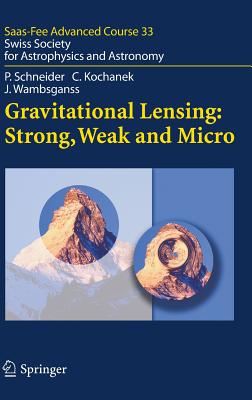
Gravitational Lensing: Strong, Weak and Micro: Swiss Society for Astrophysics and Astronomy - Hardcover
$118.99
$119.99
-1%Quantity
01
Pay over time for orders over $35.00 with
Offers & Perks
Earn 118 points with this purchase
Added to your rewards balance after checkout.
100 points welcome bonus
Create an account and start with extra points.
Availability:In StockContributor:Peter Schneider, Georges Meylan, Christopher KochanekSeries:Saas-Fee Advanced CoursePublish date:5/5/2006Pages:552
Languages:EnglishPublisher:SpringerISBN-13:9783540303091ISBN-10:354030309XUPC:9783540303091Book Category:ScienceBook Subcategory:Physics, Space ScienceBook Topic:Astrophysics, Astronomy, CosmologySize:9.37 x 6.62 x 0.99 inchesWeight:0.908Product ID:SC7PPARY2P
The observation, in 1919 by A.S. Eddington and collaborators, of the gra- tational de?ection of light by the Sun proved one of the many predictions of Einstein's Theory of General Relativity: The Sun was the ?rst example of a gravitational lens. In 1936, Albert Einstein published an article in which he suggested - ing stars as gravitational lenses. A year later, Fritz Zwicky pointed out that galaxies would act as lenses much more likely than stars, and also gave a list of possible applications, as a means to determine the dark matter content of galaxies and clusters of galaxies. It was only in 1979 that the ?rst example of an extragalactic gravitational lens was provided by the observation of the distant quasar QSO 0957+0561, by D. Walsh, R.F. Carswell, and R.J. Weymann. A few years later, the ?rst lens showing images in the form of arcs was detected. The theory, observations, and applications of gravitational lensing cons- tute one of the most rapidly growing branches of astrophysics. The gravi- tional de?ection of light generated by mass concentrations along a light path producesmagni?cation, multiplicity, anddistortionofimages, anddelaysp- ton propagation from one line of sight relative to another. The huge amount of scienti?c work produced over the last decade on gravitational lensing has clearly revealed its already substantial and wide impact, and its potential for future astrophysical applications.
Languages:EnglishPublisher:SpringerISBN-13:9783540303091ISBN-10:354030309XUPC:9783540303091Book Category:ScienceBook Subcategory:Physics, Space ScienceBook Topic:Astrophysics, Astronomy, CosmologySize:9.37 x 6.62 x 0.99 inchesWeight:0.908Product ID:SC7PPARY2P
Publisher: Springer
Edition
2006 Edition
Contributor(s)
Authors
Free shipping on orders over $75. Standard shipping takes 3-7 business days. Returns accepted within 30 days of purchase.