
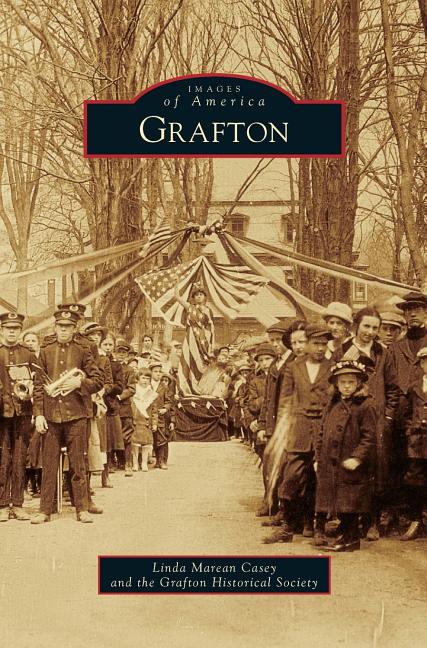
Grafton - Hardcover
$23.99
$31.99
-25%Quantity
01
Pay over time for orders over $35.00 with
Offers & Perks
Earn 23 points with this purchase
Added to your rewards balance after checkout.
100 points welcome bonus
Create an account and start with extra points.
Availability:In StockContributor:Linda Marean Casey, Grafton Historical SocietyTheme:Cultural Region/New EnglandPublish date:5/2/2016Pages:130
Languages:EnglishPublisher:Arcadia Publishing Library EditionsISBN-13:9781531698638ISBN-10:1531698638UPC:9781531698638Book Category:History, Photography, TravelBook Subcategory:United States, Subjects & Themes, PictorialsBook Topic:State & Local, HistoricalSize:9.61 x 6.69 x 0.38 inchesWeight:0.413Product ID:SC7B82E21H
Nestled in the hills 38 miles west of Boston, the area that would become Grafton originally belonged to the Nipmuc Indians. In the mid-1600s, John Eliot, a Puritan missionary, traveled throughout Massachusetts converting the natives to Christianity. He created a series of praying Indian villages, including Hassanamesit. In 1728, most of Hassanamesit was purchased by a group of investors, and in 1735 it was incorporated as the town of Grafton. By the early 19th century, Grafton was a national leader in leather tanning and shoe production. Textile mills appeared along the rivers, attracting emigrant workers from Canada and Europe. Three geographic areas evolved, each with its own identity: Grafton Center, North Grafton, and South Grafton. Today, residents celebrate the differences and salute the forces that brought them together to form one united town. Grafton is the birthplace of the famous Willard clock makers Simon, Benjamin, Ephraim, and Aaron whose home and clock shop are now the Willard House and Clock Museum. Grafton is the birthplace of Robert Bailey Thomas, the founder, editor, and publisher of the Old Farmer s Almanac. Native Jerome Wheelock invented a steam valve system, revolutionizing transportation worldwide. Grafton is also the childhood home of noted American poet Frank O Hara."
Languages:EnglishPublisher:Arcadia Publishing Library EditionsISBN-13:9781531698638ISBN-10:1531698638UPC:9781531698638Book Category:History, Photography, TravelBook Subcategory:United States, Subjects & Themes, PictorialsBook Topic:State & Local, HistoricalSize:9.61 x 6.69 x 0.38 inchesWeight:0.413Product ID:SC7B82E21H
Casey, Linda Marean: - Linda Marean Casey is the museum director of the Grafton Historical Society and served for seven years as its president. The society, incorporated in 1964, has collected and preserved this collection of photographs that tells the history of Grafton.
Publisher: Arcadia Publishing Library Editions
Contributor(s)
Free shipping on orders over $75. Standard shipping takes 3-7 business days. Eligible items may be returned within 30 days of delivery. Conditions apply.