
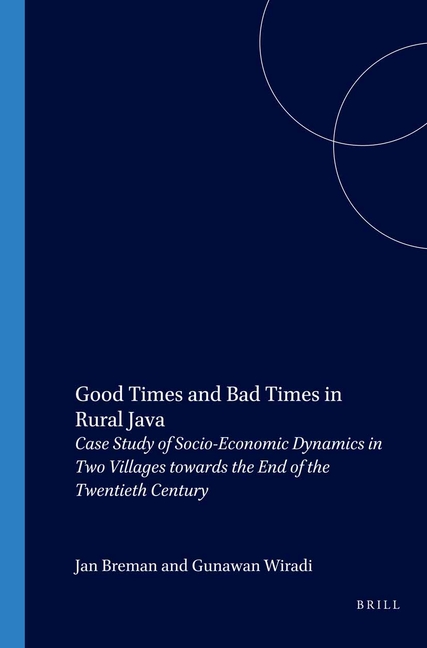
Good Times and Bad Times in Rural Java: Case Study of Socio-Economic Dynamics in Two Villages Towards the End of the Twentieth Century - Paperback
by J. Breman
$145.99
$149.00
-2%Quantity
01
Pay over time for orders over $35.00 with
Offers & Perks
Earn 145 points with this purchase
Added to your rewards balance after checkout.
100 points welcome bonus
Create an account and start with extra points.
Availability:In StockContributor:J. BremanSeries:Verhandelingen Van Het Koninklijk Instituut Voor Taal-, LandTheme:Chronological Period/18th Century, Chronological Period/19th CenturyPublish date:1/1/2002Pages:332
Languages:EnglishPublisher:BrillISBN-13:9789067181877ISBN-10:9067181870UPC:9789067181877Book Category:Social Science, HistoryBook Subcategory:Sociology, Anthropology, EuropeBook Topic:Rural, Cultural & SocialSize:9.46 x 6.42 x 0.73 inchesWeight:0.536Product ID:SCJN7A81TX
The causes of the Asian economic crisis have been the subject of fierce debates among economists, yet little is known about the impact on employment and wellbeing. In Indonesia, the worst affected country, the malaise turned into a political and societal upheaval which brought an end to the New Order regime. Based on anthropological fieldwork in two villages along the coast of West Java, the monograph discusses the repercussions for work and welfare in the rural hinterland.
The authors criticize the policies of the government of Indonesia as well as those of other transnational agencies on what has happened and what should be done. Their micro-study on socio-economic dynamics in two localities, researched in a longitudinal perspective, argues that since the start of the crisis the poverty level, then already much higher than officially conceded, rose to include more than half of all households. In contrast to the received wisdom that the village still functions as a community, the crisis has widened the gap between the rural rich and poor. The fieldwork findings are held to justify conclusions for areas with similar structural characteristics: densely populated, with a highly skewed pattern of land distribution, long-distance labour circulation between city and countryside and involving a substantial part of the total workforce, especially the landpoor and the landless.
The authors criticize the policies of the government of Indonesia as well as those of other transnational agencies on what has happened and what should be done. Their micro-study on socio-economic dynamics in two localities, researched in a longitudinal perspective, argues that since the start of the crisis the poverty level, then already much higher than officially conceded, rose to include more than half of all households. In contrast to the received wisdom that the village still functions as a community, the crisis has widened the gap between the rural rich and poor. The fieldwork findings are held to justify conclusions for areas with similar structural characteristics: densely populated, with a highly skewed pattern of land distribution, long-distance labour circulation between city and countryside and involving a substantial part of the total workforce, especially the landpoor and the landless.
Languages:EnglishPublisher:BrillISBN-13:9789067181877ISBN-10:9067181870UPC:9789067181877Book Category:Social Science, HistoryBook Subcategory:Sociology, Anthropology, EuropeBook Topic:Rural, Cultural & SocialSize:9.46 x 6.42 x 0.73 inchesWeight:0.536Product ID:SCJN7A81TX
Gunawan Wiradi graduated as a rural sociologist from the Institut Pertanian Bogor and Universiti Malaysia in Penang. He has been active for many years as a senior researcher in Survey Agro-Ekonomi and as a prominent consultant for various non government agencies. His latest book Reforma agraria: Perjalanan yang belum berakhir (2000) discusses the urgent need for land distribution in Indonesia.
Jan Breman, emeritus Professor of sociology at the Amsterdam School of Social Science Research, has a long-standing research record on the historical and contemporary change in South and Southeast Asia. His publications on Indonesia include: Java: Population growth and demographic structure (1963); The village on Java and the early colonial state (1980); Taming the coolie beast: Plantation society and the colonial order in Southeast-Asia (1989).
Jan Breman, emeritus Professor of sociology at the Amsterdam School of Social Science Research, has a long-standing research record on the historical and contemporary change in South and Southeast Asia. His publications on Indonesia include: Java: Population growth and demographic structure (1963); The village on Java and the early colonial state (1980); Taming the coolie beast: Plantation society and the colonial order in Southeast-Asia (1989).
Publisher: Brill
Free shipping on orders over $75. Standard shipping takes 3-7 business days. Eligible items may be returned within 30 days of delivery. Conditions apply.