
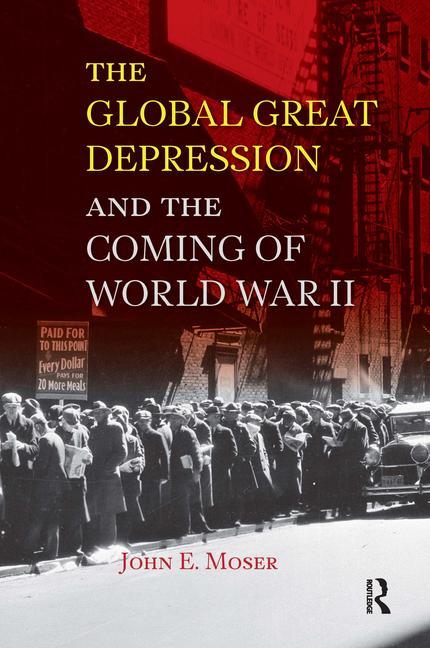
Global Great Depression and the Coming of World War II - Paperback
Pay over time for orders over $35.00 with
Offers & Perks
Earn 73 points with this purchase
Added to your rewards balance after checkout.
100 points welcome bonus
Create an account and start with extra points.
The Global Great Depression and the Coming of World War II demonstrates the ways in which the economic crisis of the late 1920s and early 1930s helped to cause and shape the course of the Second World War. Historian John E. Moser points to the essential uniformity in the way in which the world s industrialized and industrializing nations responded to the challenge of the Depression. Among these nations, there was a move away from legislative deliberation and toward executive authority; away from free trade and toward the creation of regional trading blocs; away from the international gold standard and toward managed national currencies; away from chaotic individual liberty and toward rational regimentation; in other words, away from classical liberalism and toward some combination of corporatism, nationalism, and militarism.For all the similarities, however, there was still a great divide between two different general approaches to the economic crisis. Those countries that enjoyed easy, unchallenged access to resources and markets the United States, Great Britain, the Soviet Union, and France tended to turn inward, erecting tariff walls and promoting domestic recovery at the expense of the international order. On the other hand, those nations that lacked such access Germany and Japan sought to take the necessary resources and markets by force. The interplay of these powers, then, constituted the dynamic of international relations of the 1930s: have-nots attempting to achieve self-sufficiency through aggressive means, challenging haves that were too distrustful of one another, and too preoccupied with their own domestic affairs, to work cooperatively in an effort to stop them.
John E. Moser is Professor of History at Ashland University, where he teaches courses on modern European, American, and East Asian history. His previous books include Twisting the Lion's Tail: American Anglophobia between the World Wars (New York University Press, 1999), Presidents from Hoover through Truman, 1929â "1952 (Greenwood Press, 2001), and Right Turn: John T. Flynn and the Transformation of American Liberalism (New York University Press, 2005).
Contributor(s)
Author
Free shipping on orders over $75. Standard shipping takes 3-7 business days. Eligible items may be returned within 30 days of delivery. Conditions apply.