Surprise Castle
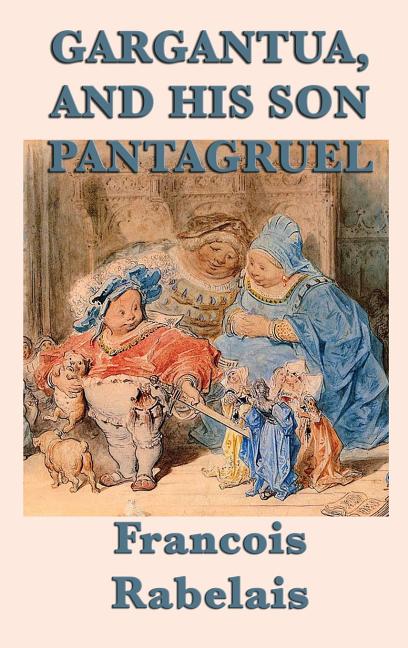
Gargantua, and His Son Pantagruel: A Classic Renaissance Satire of Giants, Learning, Appetite, and Folly

Gargantua, and His Son Pantagruel: A Classic Renaissance Satire of Giants, Learning, Appetite, and Folly - Hardcover

$36.99
Quantity
01

Pay over time for orders over $35.00 with

Offers & Perks

Earn 36 points with this purchase

Added to your rewards balance after checkout.

100 points welcome bonus

Create an account and start with extra points.

Join now
Availability:In StockContributor:Francois RabelaisPublish date:4/3/2018Pages:676
Languages:EnglishPublisher:SMK BooksISBN-13:9781515426042ISBN-10:1515426041UPC:9781515426042Book Category:FictionBook Subcategory:Fairy Tales, Folk Tales, Legends & Mythology, Fantasy, SatireBook Topic:HistoricalSize:9.21 x 6.14 x 1.63 inchesWeight:1.208Product ID:SCGSX6GKBB

François Rabelais's Gargantua, and His Son Pantagruel is one of the great comic monuments of Renaissance literature: bawdy, learned, grotesque, brilliant, unruly, and ferociously satirical. Published across five books between 1532 and 1564, the work follows the giant Gargantua, his son Pantagruel, and their companions through a world of absurd battles, learned jokes, bodily excess, legal nonsense, religious mockery, educational reform, philosophical debate, and comic invention. Britannica identifies Gargantua and Pantagruel as a collective title for five comic novels published between 1532 and 1564, using the giants' adventures to ridicule the follies and superstitions of the age.

Rabelais is not polite, tidy, or decorous. His comedy moves from high humanist learning to outrageous vulgarity, from theological and legal satire to sheer verbal abundance. The giants are not simply fantastic figures; they are engines of comic enlargement, allowing Rabelais to magnify the absurdity of institutions, customs, scholastic pedantry, war, appetite, authority, and fear. Project Gutenberg describes the work as a sixteenth-century pentalogy of novels chronicling the adventures of Gargantua and Pantagruel in an extravagant, satirical style filled with erudition, vulgarity, and wordplay.

For readers of classic satire, Renaissance literature, French classics, comic fiction, grotesque literature, and the history of the novel, Gargantua, and His Son Pantagruel remains essential. The Urquhart and Motteux English translation is itself a famous literary performance, carrying Rabelais's exuberance into English with enormous energy and invention. This is a foundational work of European comic literature: excessive by design, learned by instinct, obscene by temperament, and still alive with the force of a writer determined to make language itself laugh.

Languages:EnglishPublisher:SMK BooksISBN-13:9781515426042ISBN-10:1515426041UPC:9781515426042Book Category:FictionBook Subcategory:Fairy Tales, Folk Tales, Legends & Mythology, Fantasy, SatireBook Topic:HistoricalSize:9.21 x 6.14 x 1.63 inchesWeight:1.208Product ID:SCGSX6GKBB
Rabelais, Francois: - François Rabelais was a French Renaissance writer, humanist, physician, monk, scholar, and satirist whose Gargantua and Pantagruel became one of the central comic works of European literature. Born in the late fifteenth century, Rabelais lived through a period of intense religious, intellectual, and political change. His writing reflects the humanist learning of the Renaissance, but it also refuses solemnity, decorum, and narrow authority. He brought together classical scholarship, popular farce, parody, medical knowledge, theological controversy, legal satire, folk humour, and verbal excess in a way that made his work unlike almost anything before it. Britannica describes him as a physician and humanist, remembered above all for the comic masterpiece Gargantua and Pantagruel.Rabelais's fiction is expansive in every sense. His giants eat, drink, fight, travel, debate, joke, blaspheme, study, and philosophise on a scale that turns ordinary life into carnival. Beneath the comic violence and vulgarity lies a sharp attack on pedantry, superstition, cruelty, legal corruption, bad education, empty ceremony, and religious repression. His work helped enlarge the possibilities of prose fiction, showing that the novel could be comic, encyclopedic, philosophical, obscene, learned, popular, and intellectually serious all at once.Though Rabelais's books were controversial in their own time, they have remained central to the study of Renaissance literature, satire, comic prose, and the development of the European novel. His influence can be felt in later traditions of grotesque comedy, linguistic play, intellectual parody, and satirical fiction. To read Rabelais is to enter a world where appetite becomes philosophy, laughter becomes criticism, and excess becomes a literary method.
Publisher: SMK Books

Free shipping on orders over $75. Standard shipping takes 3-7 business days. Eligible items may be returned within 30 days of delivery. Conditions apply.