
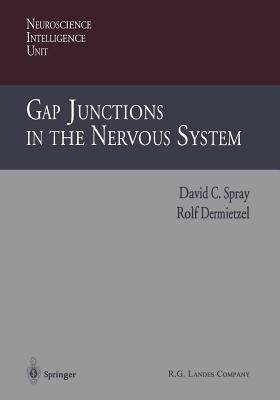
Gap Junctions in the Nervous System - Paperback
$108.99
$109.99
-1%Quantity
01
Pay over time for orders over $35.00 with
Offers & Perks
Earn 108 points with this purchase
Added to your rewards balance after checkout.
100 points welcome bonus
Create an account and start with extra points.
Availability:In StockContributor:David C. Spray, Rolf DermietzelSeries:Neuroscience Intelligence UnitPublish date:11/13/2013Pages:317
Languages:EnglishPublisher:SpringerISBN-13:9783662219379ISBN-10:3662219379UPC:9783662219379Book Category:Medical, ScienceBook Subcategory:Neuroscience, Life SciencesBook Topic:Molecular Biology, Cell BiologySize:10.00 x 7.00 x 0.70 inchesWeight:0.586Product ID:SCHCA0JFH8
A Cytoplasm Connexon or Hemichannel Cytoplasm external loop I - P. M. N-Termlnus Fig. 1. 1. Topology of gap junction channels. (A) Cap junction channels, extending from the cytoplasm of one cell to the cytoplasm of another, are formed by two connexons or hemichannels connected across extracellular space. (B) Each connexon is formed from six connexin subunits, each having four membrane-spanning domains and both amino and carboxyl termini within the cytoplasm. External/oops (I and II} are believed to provide the high affinity interactions between the hemichannels. 4 Gap }unctions in the Nervous System P-region of voltage sensitive nonjunctional molecules; these contributed disulfide 9 channels. And Delmar's group has ob- bridges are presumably involved in intra- tained evidence that intracellular acidifi- connexin and inter-EL loop tertiary struc- cation may result in a conformational ture. An old observation that should be change analogous to the ball and chain repeated stoichiometrically with modern techniques is that gap junction channels model of inactivation of voltage gated ionic can be split into connexons or hemi- channels, whereby the carboxyl terminal channels using hyperosmotic disaccharide portion of connexin43 binds to CL, closing 23 solutions again implying that linkage is the channel. Higher order structure of the channel not covalent. is believed to consist of six connexins form- ing the hemichannel or connexon in a 3.
Languages:EnglishPublisher:SpringerISBN-13:9783662219379ISBN-10:3662219379UPC:9783662219379Book Category:Medical, ScienceBook Subcategory:Neuroscience, Life SciencesBook Topic:Molecular Biology, Cell BiologySize:10.00 x 7.00 x 0.70 inchesWeight:0.586Product ID:SCHCA0JFH8
Publisher: Springer
Edition
Softcover Repri Edition
Contributor(s)
Free shipping on orders over $75. Standard shipping takes 3-7 business days. Returns accepted within 30 days of purchase.