
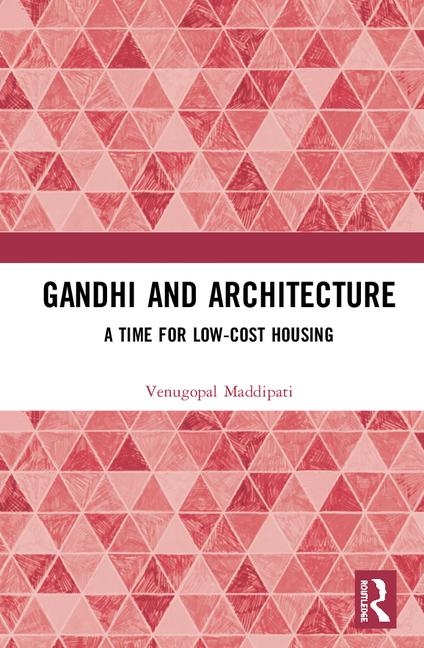
Gandhi and Architecture: A Time for Low-Cost Housing - Hardcover
Pay over time for orders over $35.00 with
Offers & Perks
Earn 231 points with this purchase
Added to your rewards balance after checkout.
100 points welcome bonus
Create an account and start with extra points.
Gandhi and Architecture: A Time for Low-Cost Housing chronicles the emergence of a low-cost, low-rise housing architecture that conforms to M.K. Gandhi's religious need to establish finite boundaries for everyday actions; finitude in turn defines Gandhi's conservative and exclusionary conception of religion. Drawing from rich archival and field materials, the book begins with an exploration of Gandhi's religiosity of relinquishment and the British Spiritualist, Madeline Slade's creation of his low-cost hut, Adi Niwas, in the village of Segaon in the 1930s. Adi Niwas inaugurates a low-cost housing architecture of finitude founded on the near-simultaneous but heterogeneous, conservative Gandhian ideals of pursuing self-sacrifice and rendering the pursuit of self-sacrifice legible as the practice of an exclusionary varnashramadharma.
At a considerable remove from Gandhi's religious conservatism, successive generations in post-colonial India have reimagined a secular necessity for this Gandhian low-cost housing architecture of finitude. In the early 1950s era of mass housing for post-partition refugees from Pakistan, the making of a low-cost housing architecture was premised on the necessity of responding to economic concerns and to an emerging demographic mandate. In the 1970s, during the Organization of Petroleum Exporting Countries crisis, it was premised on the rise of urban and climatological necessities. More recently, in the late 1990s and early 2000s, its reception has been premised on the emergence of language-based identitarianism in Wardha, Maharashtra. Each of these moments of necessity reveals the enduring present of a Gandhian low-cost housing architecture of finitude and also the need to emancipate Gandhian finitude from Gandhi's own exclusions.
This volume is a critical intervention in the philosophy of architectural history. Drawing eclectically from science and technology studies, political science, housing studies, urban studies, religious studies, and anthropology, this richly illustrated volume will be of great interest to students and researchers of architecture and design, housing, history, sociology, economics, Gandhian studies, urban studies and development studies.
Venugopal Maddipati is Assistant Professor in the School of Design at Ambedkar University Delhi, India. His research focuses on building as poesis, housing thinking, geological thinking, and ecological aesthetics. His publications include of Water Histories of South Asia: The Materiality of Liquescence (coedited, 2019) and essays in journals and books, such as South Asia: Journal of South Asian Studies; Sarai Reader 09; Simon Starling/Superflex: Reprototypes, Triangulations and Road Tests; MARG; and LA, Journal of Landscape Architecture.
Contributor(s)
Author
Free shipping on orders over $75. Standard shipping takes 3-7 business days. Eligible items may be returned within 30 days of delivery. Conditions apply.