
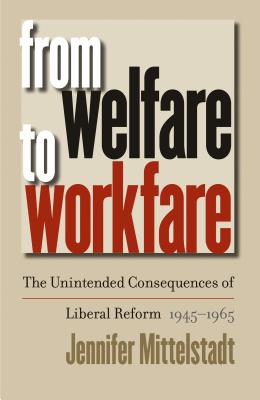
From Welfare to Workfare: The Unintended Consequences of Liberal Reform, 1945-1965 - Paperback
$44.99
Quantity
01
Pay over time for orders over $35.00 with
Offers & Perks
Earn 44 points with this purchase
Added to your rewards balance after checkout.
100 points welcome bonus
Create an account and start with extra points.
Availability:In StockContributor:Jennifer MittelstadtSeries:Gender and American CultureTheme:Chronological Period/1940's, Chronological Period/1950's, Chronological Period/1960's, Chronological Period/20th Century, Sex & Gender/FemininePublish date:3/7/2005Pages:288
Languages:EnglishPublisher:University of North Carolina PressISBN-13:9780807855874ISBN-10:0807855871UPC:9780807855874Book Category:Political Science, History, Social ScienceBook Subcategory:Public Policy, United States, Gender StudiesBook Topic:Social Services & Welfare, 20th CenturySize:9.30 x 6.10 x 0.69 inchesWeight:0.4Product ID:SC6JP4BQJN
In 1996, Democratic president Bill Clinton and the Republican-controlled Congress "ended welfare as we know it" and trumpeted "workfare" as a dramatic break from the past. But, in fact, workfare was not new. Jennifer Mittelstadt locates the roots of the 1996 welfare reform many decades in the past, arguing that women, work, and welfare were intertwined concerns of the liberal welfare state beginning just after World War II.
Mittelstadt examines the dramatic reform of Aid to Dependent Children (ADC) from the 1940s through the 1960s, demonstrating that in this often misunderstood period, national policy makers did not overlook issues of poverty, race, and women's role in society. Liberals' public debates and disagreements over welfare, however, caused unintended consequences, she argues, including a shift toward conservatism. Rather than leaving ADC as an income support program for needy mothers, reformers recast it as a social services program aimed at "rehabilitating" women from "dependence" on welfare to "independence," largely by encouraging them to work. Mittelstadt reconstructs the ideology, implementation, and consequences of rehabilitation, probing beneath its surface to reveal gendered and racialized assumptions about the welfare poor and broader societal concerns about poverty, race, family structure, and women's employment.
Mittelstadt examines the dramatic reform of Aid to Dependent Children (ADC) from the 1940s through the 1960s, demonstrating that in this often misunderstood period, national policy makers did not overlook issues of poverty, race, and women's role in society. Liberals' public debates and disagreements over welfare, however, caused unintended consequences, she argues, including a shift toward conservatism. Rather than leaving ADC as an income support program for needy mothers, reformers recast it as a social services program aimed at "rehabilitating" women from "dependence" on welfare to "independence," largely by encouraging them to work. Mittelstadt reconstructs the ideology, implementation, and consequences of rehabilitation, probing beneath its surface to reveal gendered and racialized assumptions about the welfare poor and broader societal concerns about poverty, race, family structure, and women's employment.
Languages:EnglishPublisher:University of North Carolina PressISBN-13:9780807855874ISBN-10:0807855871UPC:9780807855874Book Category:Political Science, History, Social ScienceBook Subcategory:Public Policy, United States, Gender StudiesBook Topic:Social Services & Welfare, 20th CenturySize:9.30 x 6.10 x 0.69 inchesWeight:0.4Product ID:SC6JP4BQJN
Jennifer Mittelstadt is assistant professor of history and women's studies at Pennsylvania State University.
Publisher: University of North Carolina Press
Contributor(s)
Author
Free shipping on orders over $75. Standard shipping takes 3-7 business days. Eligible items may be returned within 30 days of delivery. Conditions apply.