
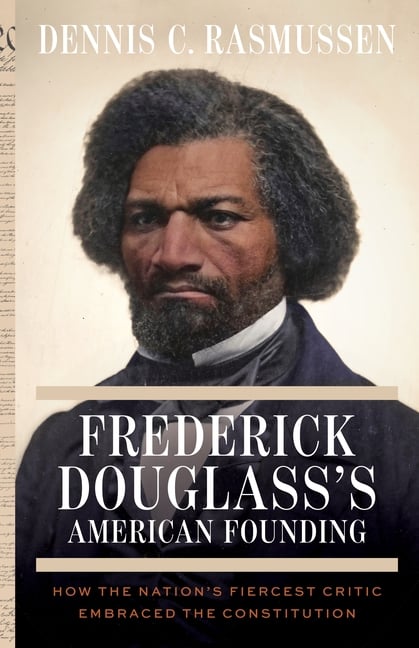
Frederick Douglass's American Founding: How the Nation's Fiercest Critic Embraced the Constitution - Hardcover
$20.99
$27.95
-25%Quantity
01
Pay over time for orders over $35.00 with
Offers & Perks
Earn 20 points with this purchase
Added to your rewards balance after checkout.
100 points welcome bonus
Create an account and start with extra points.
Availability:In StockContributor:Dennis C. RasmussenTheme:Ethnic Orientation/African AmericanPublish date:9/15/2026Pages:216
Languages:EnglishPublisher:Princeton University PressISBN-13:9780691294025ISBN-10:069129402XUPC:9780691294025Book Category:History, Social ScienceBook Subcategory:African American & Black, United States, EnslavementSize:8.60 x 5.60 x 0.90 inchesWeight:0.431Product ID:SC6CHB6096
The remarkable story of how Frederick Douglass went from condemning the Constitution as a proslavery pact to celebrating it as a "glorious liberty document" that promises freedom to everyone
The speeches and writings of Frederick Douglass contain some of the most probing examinations ever of the role that slavery played in America's founding. In Frederick Douglass's American Founding, Dennis Rasmussen traces the great abolitionist's intellectual journey from denouncing the founders as hypocrites and the Constitution as evil to embracing them both. Throughout the 1840s, Douglass described the founders as "little better than a band of pirates" and the Constitution as "a most cunningly-devised and wicked compact." Beginning in 1849, however, he undertook a long period of study and reflection that produced a dramatic change of mind. From 1851 on, Douglass contended that the founders were resolutely opposed to slavery and that the Constitution was a "glorious liberty document" that mandated immediate emancipation, despite several clauses that appeared to suggest otherwise. Even after embracing the Constitution and the founders, Douglass remained second to none in castigating America for the evils of slavery. Indeed, as he argued in his greatest speech, "What to the Slave Is the Fourth of July?" (1852), the glory of the nation's founding ideals only put their persistent betrayal into starker relief. Douglass also came to regard the founders as radicals in their fight against tyranny. That was why he insisted that he and his fellow abolitionists, rather than moderates like Abraham Lincoln, were the founders' true heirs. Whatever you think about the founding, Douglass's arguments will challenge--and perhaps even change--your views. After seeing the Constitution through Douglass's eyes, it is difficult to look at it in the same way again.Languages:EnglishPublisher:Princeton University PressISBN-13:9780691294025ISBN-10:069129402XUPC:9780691294025Book Category:History, Social ScienceBook Subcategory:African American & Black, United States, EnslavementSize:8.60 x 5.60 x 0.90 inchesWeight:0.431Product ID:SC6CHB6096
Dennis C. Rasmussen is professor of political science and the Hagerty Family Fellow at Syracuse University's Maxwell School of Citizenship and Public Affairs. His books include Fears of a Setting Sun: The Disillusionment of America's Founders and The Infidel and the Professor: David Hume, Adam Smith, and the Friendship That Shaped Modern Thought (both Princeton).
Publisher: Princeton University Press
Contributor(s)
Author
Free shipping on orders over $75. Standard shipping takes 3-7 business days. Eligible items may be returned within 30 days of delivery. Conditions apply.