
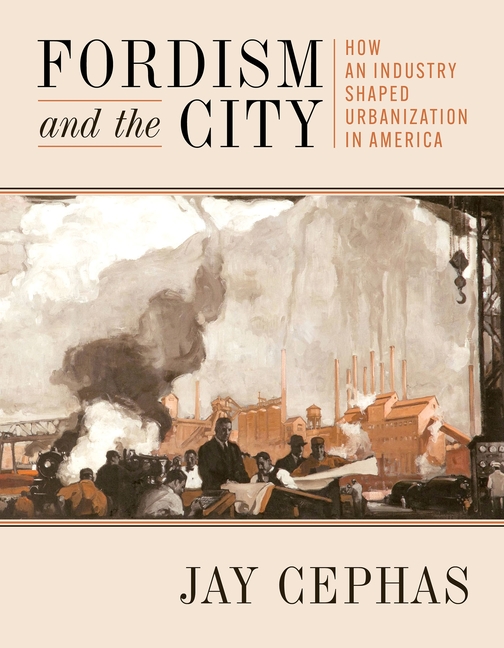
Fordism and the City: How an Industry Shaped Urbanization in America - Paperback
by Jay Cephas
$44.99
$45.00
Quantity
01
Pay over time for orders over $35.00 with
Offers & Perks
Earn 44 points with this purchase
Added to your rewards balance after checkout.
100 points welcome bonus
Create an account and start with extra points.
Availability:In StockContributor:Jay CephasSeries:History of the Urban EnvironmentTheme:Chronological Period/20th Century, Demographic Orientation/Urban, Topical/EcologyPublish date:4/7/2026Pages:384
Languages:EnglishPublisher:University of Pittsburgh PressISBN-13:9780822967958ISBN-10:0822967952UPC:9780822967958Book Category:History, ArchitectureBook Subcategory:Historical Geography, United States, Urban & Land Use PlanningBook Topic:20th CenturySize:9.03 x 7.13 x 0.81 inchesWeight:0.872Product ID:SC3AQPZT8A
In the early twentieth century, the Ford Motor Company built an industrial empire with massive factory complexes and associated infrastructures. Henry Ford's 1915 plan to decentralize industrial manufacturing relied on moving key technical processes closer to sites of resource extraction while distributing elements of production. In Fordism and the City, Jay Cephas analyzes key infrastructures--from factories and mills to roads, rail lines, and canals--to trace the impact of automated, assembly-line production on the urban and rural landscapes of Michigan. The overwhelming scale of the Ford Motor Company's plant in Dearborn, the idyllic setting of its small village factories throughout the Rouge River corridor, and the remoteness of the company's iron ore mines and hardwood forests in the Upper Peninsula all played an important role. Under the rubric of "the industrial city," Fordism sought to replace conventional urbanism, reconfiguring factory production and then making its practices visible and intelligible to a consuming public through an industrial aesthetic. In doing so, Cephas shows, Fordism functioned as a normalizing force that helped to usher in the new industrial society.
Languages:EnglishPublisher:University of Pittsburgh PressISBN-13:9780822967958ISBN-10:0822967952UPC:9780822967958Book Category:History, ArchitectureBook Subcategory:Historical Geography, United States, Urban & Land Use PlanningBook Topic:20th CenturySize:9.03 x 7.13 x 0.81 inchesWeight:0.872Product ID:SC3AQPZT8A
Jay Cephas is a historian who studies the impact of labor, technology, and social identity on the built environment. He is assistant professor in the history and theory of architecture at Princeton University, where he is also a research director of the Princeton-Mellon Initiative in Architecture, Urbanism, and the Humanities. Cephas is also the founding director of the Black Architects Archive, an interactive repository that documents the physical, intellectual, and creative labor deployed by the Black architects, builders, landscape architects, and contractors who helped shape the American built environment across the nineteenth and twentieth centuries. Cephas was recently named a Conserving Black Modernism Fellow at the African American Cultural Heritage Action Fund of the National Trust for Historic Preservation. Cephas is a member of the African American Intellectual History Society, Urban History Association, Society for American City and Regional Planning History, Labor and Working Class History Association, Society for the History of Technology, and Society of Architectural Historians.
Publisher: University of Pittsburgh Press
Contributor(s)
Author
Free shipping on orders over $75. Standard shipping takes 3-7 business days. Returns accepted within 30 days of purchase.