
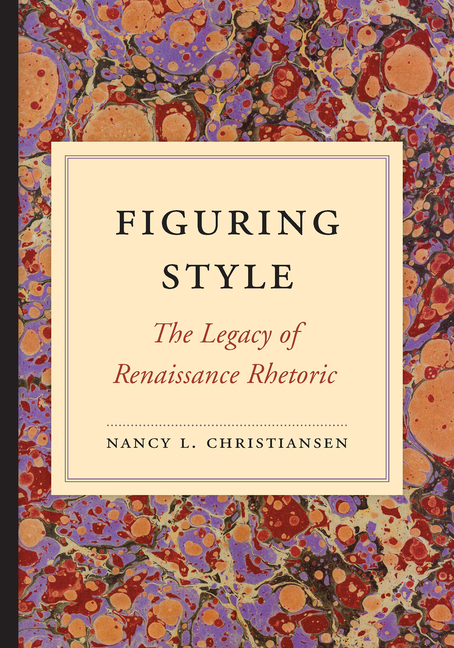
Figuring Style: The Legacy of Renaissance Rhetoric - Hardcover
$135.99
Quantity
01
Pay over time for orders over $35.00 with
Offers & Perks
Earn 135 points with this purchase
Added to your rewards balance after checkout.
100 points welcome bonus
Create an account and start with extra points.
Availability:In StockContributor:Nancy L. ChristiansenSeries:Studies in Rhetoric & CommunicationPublish date:8/8/2013Pages:652
Languages:EnglishPublisher:University of South Carolina PressISBN-13:9781611172409ISBN-10:1611172403UPC:9781611172409Book Category:Language Arts & Disciplines, HistoryBook Subcategory:Rhetoric, EuropeBook Topic:RenaissanceSize:10.00 x 7.00 x 1.38 inchesWeight:1.339Product ID:SCGE8TK7QV
Nancy L. Christiansen provides a broad and deep introduction to the discussion of rhetorical stylistic instruction in the English Renaissance. She argues that most contemporary characterizations of Renaissance stylistic theory are reductions obscuring the comprehensive composing and reading method taught by Renaissance rhetoricians. At the core of her discussion is the concept of figures, and Christiansen traces the nomenclature of the figures back to its origins, observing how these terms have mutated, fused, and confused over the centuries. Renaissance figures serve, she argues, to structure all three dimensions of language-speech, thought, and action. As a consequence, in the Renaissance paradigm there are not two types of language, figured and unfigured, but a single language composed of a web of figures. Christiansen makes the largest possible claims for the figures as representing discourse "forms" at all levels and as providing an ethical center for cultural practices. She also notes that the figures anticipate some elements of contemporary cognitive linguistics. Her discussion includes a substantial review of rhetorical history to create a lineage from Isocratean/Ciceronian rhetorical theory to the work of Ascham, Puttenham, and others. She also offers a demonstration of these principles in textual analysis by applying them to passages from Shakespeare's Titus Andronicus and Sonnet 129 and from Milton's Paradise Lost. The resulting explications illustrate not only the primacy of figures to text and their substantive nature, but also the comprehensiveness and insightfulness of such a reading method. Completing her treatment of Renaissance style is a comprehensive handlist of figures, from phonetic and morphological through logical, discoursal, and qualitative categories, along with definitions and examples from both classical and Renaissance sources. The result is a handbook that demystifies Renaissance theory and practice of style in its own historical, philosophical, and pedagogical contexts.
Languages:EnglishPublisher:University of South Carolina PressISBN-13:9781611172409ISBN-10:1611172403UPC:9781611172409Book Category:Language Arts & Disciplines, HistoryBook Subcategory:Rhetoric, EuropeBook Topic:RenaissanceSize:10.00 x 7.00 x 1.38 inchesWeight:1.339Product ID:SCGE8TK7QV
Nancy L. Christiansen is an associate professor of English at Brigham Young University and a contributor to Dialogues & Conversations, second edition, and Intertexts: Reading Pedagogy in College Writing Classrooms.
Publisher: University of South Carolina Press
Contributor(s)
Author
Free shipping on orders over $75. Standard shipping takes 3-7 business days. Eligible items may be returned within 30 days of delivery. Conditions apply.