
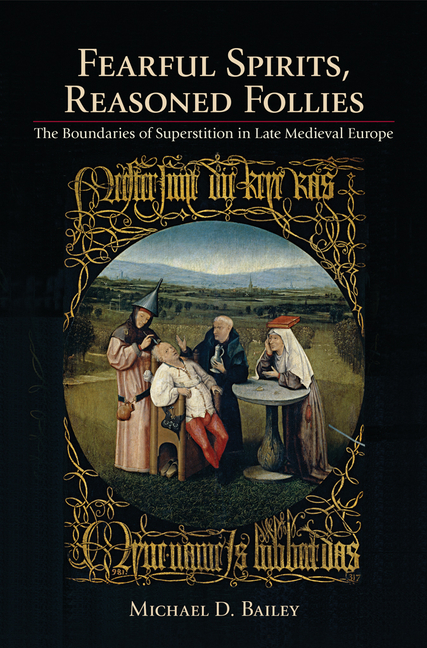
Fearful Spirits, Reasoned Follies: The Boundaries of Superstition in Late Medieval Europe - Paperback
Pay over time for orders over $35.00 with
Offers & Perks
Earn 46 points with this purchase
Added to your rewards balance after checkout.
100 points welcome bonus
Create an account and start with extra points.
Superstitions are commonplace in the modern world. Mostly, however, they evoke innocuous images of people reading their horoscopes or avoiding black cats. Certain religious practices might also come to mind--praying to St. Christopher or lighting candles for the dead. Benign as they might seem today, such practices were not always perceived that way. In medieval Europe superstitions were considered serious offenses, violations of essential precepts of Christian doctrine or immutable natural laws. But how and why did this come to be? In Fearful Spirits, Reasoned Follies, Michael D. Bailey explores the thorny concept of superstition as it was understood and debated in the Middle Ages.
Bailey begins by tracing Christian thinking about superstition from the patristic period through the early and high Middle Ages. He then turns to the later Middle Ages, a period that witnessed an outpouring of writings devoted to superstition--tracts and treatises with titles such as De superstitionibus and Contra vitia superstitionum. Most were written by theologians and other academics based in Europe's universities and courts, men who were increasingly anxious about the proliferation of suspect beliefs and practices, from elite ritual magic to common healing charms, from astrological divination to the observance of signs and omens. As Bailey shows, however, authorities were far more sophisticated in their reasoning than one might suspect, using accusations of superstition in a calculated way to control the boundaries of legitimate religion and acceptable science. This in turn would lay the conceptual groundwork for future discussions of religion, science, and magic in the early modern world. Indeed, by revealing the extent to which early modern thinkers took up old questions about the operation of natural properties and forces using the vocabulary of science rather than of belief, Bailey exposes the powerful but in many ways false dichotomy between the "superstitious" Middle Ages and "rational" European modernity.
Michael D. Bailey is Associate Professor of History at Iowa State University. He is the author of Battling Demons: Witchcraft, Heresy, and Reform in the Late Middle Ages; Historical Dictionary of Witchcraft; and Magic and Superstition in Europe: A Concise History from Antiquity to the Present.
Contributor(s)
Author
Free shipping on orders over $75. Standard shipping takes 3-7 business days. Returns accepted within 30 days of purchase.